What are industrial asset monitoring solutions?
Industrial asset monitoring solutions use technologies such as thermal imaging, sensors, software, and alerts to track equipment condition and detect abnormal operating patterns. In MoviTHERM’s case, thermal monitoring focuses on temperature behavior, helping teams identify overheating components, fire risks, and developing failures early so they can plan maintenance, improve safety, and reduce unplanned downtime.
How does thermal imaging help with asset monitoring?
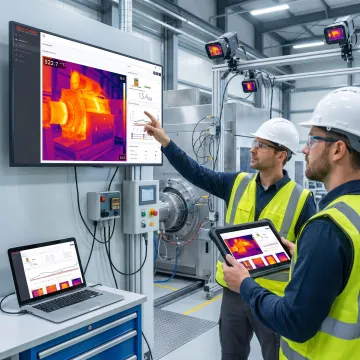
Thermal imaging reveals heat patterns that are often invisible during standard visual inspections. By continuously monitoring assets or performing targeted inspections, teams can detect hot spots, overloaded electrical components, friction issues, insulation failures, and process abnormalities. This allows earlier intervention, faster troubleshooting, and safer inspections because the method is non-contact and does not require gels, couplants, or ionizing radiation.
Which industries benefit most from industrial asset monitoring?
Industrial asset monitoring is especially valuable in American manufacturing, utilities, battery production and storage, logistics, aerospace, electronics, recycling, renewable energy, oil and gas, and process industries. Any operation with critical equipment, elevated fire risk, or costly downtime can benefit. MoviTHERM supports applications ranging from substations and warehouses to data centers, battery systems, and advanced manufacturing environments.
Can these systems provide remote alerts and continuous monitoring?
Yes. MoviTHERM offers continuous thermal monitoring systems with remote access and 24/7 alerting through text, voice, and email. Teams can review thermal images, temperature trends, and alarm conditions from connected platforms without being physically present at the asset. This is especially useful for unattended facilities, high-risk storage areas, and operations that need immediate awareness of abnormal heat events.
What types of assets can be monitored with thermal imaging?
Thermal imaging can monitor a wide range of assets, including motors, bearings, conveyors, switchgear, transformers, substations, battery systems, EV charging infrastructure, servers, bulk material piles, warehouse storage zones, and process equipment. It is also effective for quality and inspection applications involving composites and electronics. The right configuration depends on asset criticality, viewing distance, environmental conditions, and alarm requirements.
Is industrial thermal monitoring suitable for fire prevention?
Yes. Thermal monitoring is widely used for early fire detection because it identifies abnormal heat buildup before smoke or flames appear. Applications include warehouses, landfills, recycling operations, battery storage, data centers, and bulk material piles. By detecting hotspots and smoldering conditions early, operators can respond faster, reduce escalation risk, and strengthen site safety protocols with automated alarms and continuous surveillance.
How is a custom monitoring solution designed?
A custom solution typically starts with understanding the asset, process, or hazard being monitored. MoviTHERM then helps define camera type, field of view, mounting position, coverage strategy, networking needs, alarm thresholds, and software integration. This planning ensures the system fits the environment and operational goals, whether the priority is predictive maintenance, fire prevention, quality assurance, or remote condition visibility.
How quickly can inspections be performed with infrared methods?
Infrared inspections are typically much faster than many conventional methods because they capture temperature information instantly and without physical contact. MoviTHERM notes that inspections can take seconds to minutes and may be up to 10 times faster than ultrasound in certain applications. That speed helps reduce bottlenecks, improve throughput, and make routine monitoring more practical across larger asset populations.