Introduction
Industrial fires don't announce themselves. According to NFPA research, U.S. fire departments responded to an average of 36,784 industrial and manufacturing fires annually from 2017–2021, causing $1.5 billion in direct property damage each year. The U.S. Fire Administration reports that modern structure fires can progress from a small flame to full flashover in just 3 to 5 minutes — far less time than most manual response protocols allow.
In environments like battery storage facilities, recycling centers, or manufacturing lines, the consequences of late detection aren't just financial. Hazardous materials, continuous operations, and high-value equipment make every second count.
Fixed fire detection systems exist for exactly these environments. Unlike portable extinguishers or manual call points, they're permanently installed, continuously monitoring, and engineered to trigger an alert or suppression response automatically — before anyone notices the fire first.
This guide breaks down how fixed detection systems work, the main technologies involved (including thermal imaging), key components, governing standards, and the maintenance obligations facility teams are responsible for.
Key Takeaways
- Fixed fire detection systems are permanently installed networks that identify fire signatures and trigger alarms or suppression responses without manual intervention
- Primary detection technologies include smoke, heat, and flame sensors; thermal imaging catches heat anomalies before smoke or flame appear
- Core compliance standards: OSHA 29 CFR 1910.164 (detection), 29 CFR 1910.160 (suppression), and NFPA 72 (2025 edition)
- Testing intervals vary by component: flame detectors require quarterly checks, smoke and heat detectors annual
- Thermal camera systems complement — not replace — code-required detectors, adding a pre-incipient warning layer in high-risk industrial facilities
What Is a Fixed Fire Detection System?
A fixed fire detection system is a permanently installed network of sensors, detectors, a control panel, and notification devices, engineered to identify fire conditions automatically and alert occupants or trigger a response without human input.
The distinction between detection and suppression matters both practically and legally. Detection systems identify a fire and raise the alarm. Suppression systems (sprinklers, gas agents, water mist) actively extinguish it. OSHA codifies this split: 29 CFR 1910.164 governs automatic fire detection equipment, while 29 CFR 1910.160 covers fixed extinguishing systems. A facility may have detection obligations under 1910.164 even if it doesn't operate a suppression system under 1910.160.
That regulatory distinction plays out across a wide range of industrial settings. Common applications include:
- Battery energy storage systems (BESS) and EV charging infrastructure
- Data centers and server rooms
- Manufacturing lines and process equipment areas
- Warehouses and distribution centers
- Waste and recycling facilities
- Electrical substations and control rooms
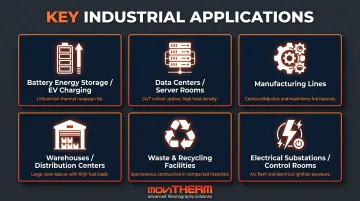
In each of these settings, the system's value comes down to timing. An early detection signal — before visible flames appear — is what separates a contained incident from a facility-wide emergency.
Types of Fixed Fire Detection Systems
Choosing the right detection technology requires matching the system to the hazard profile. Dust, humidity, temperature extremes, false alarm tolerance, and fire type (flaming vs. smoldering vs. thermal runaway) all influence which technology performs best in a given space.
Smoke Detection Systems
Ionization detectors use a small amount of radioactive material (Americium-241) to ionize air between two electrodes. Smoke particles disrupt the current and trigger an alarm. They respond quickly to fast-flaming fires with small particles, but they're prone to nuisance alarms from industrial dust, steam, and airborne particulates.
Photoelectric detectors use a light-scattering principle: smoke deflects a light beam onto a sensor, triggering the alarm. They outperform ionization types for smoldering fires and produce fewer false alarms in dusty environments. NFPA recommends using both technologies together for comprehensive coverage.
Aspirating smoke detection (ASD) actively draws air samples through a pipe network to a central detection unit. ASD systems detect minute smoke concentrations before they reach levels visible to conventional spot detectors — making them well suited for data centers, clean rooms, and high-ceiling warehouses where early warning is critical.
Heat Detection Systems
Fixed-temperature heat detectors activate when ambient temperature reaches a preset threshold — commonly 135°F (57°C) for standard environments or 200°F (93°C) and above for high-ambient spaces. They're highly reliable with low false alarm rates, though thermal lag means they respond only after surrounding air reaches the rated temperature. Best suited for dusty, steamy, or corrosive areas where smoke detectors can't function reliably.
Rate-of-rise detectors respond when temperature climbs faster than a set rate — typically 12–15°F (6.7–8.3°C) per minute — regardless of absolute temperature. This makes them faster to respond in scenarios where fire develops quickly. Most modern units combine both rate-of-rise and fixed-temperature elements in a single device.
Flame and Thermal Imaging Detection
UV flame detectors sense ultraviolet radiation emitted by flames, often responding within milliseconds. The limitation: they can false-trigger from welding arcs, lightning, or reflected sunlight.
IR flame detectors target the infrared signature of hydrocarbon combustion (around 4.3 micrometers, corresponding to CO₂ emissions from burning fuel), with better immunity to solar interference. Multi-spectrum IR and UV/IR combination detectors add algorithm-based filtering to reduce false alarms further — these are standard in petrochemical plants, aircraft hangars, and offshore platforms.
Thermal/infrared camera-based detection operates on a fundamentally different principle. Rather than waiting for smoke or flame to appear, fixed thermal cameras create continuous temperature maps of a monitored area and flag anomalies the moment temperature behavior deviates from baseline. This pre-incipient capability is especially valuable in:
- Battery storage facilities — thermal runaway in lithium-ion cells begins as a temperature anomaly, often long before gas or smoke is detectable
- Waste and recycling centers — combustible material piles develop internal heat buildup that no periodic inspection can catch consistently
- Warehouses and distribution centers — stored materials and high-density racking create zones where traditional point detectors have limited coverage
MoviTHERM's fixed thermal imaging systems — using FLIR A-Series cameras (A50, A70, A310, A615) and Optris PI and Xi Series cameras — deliver 24/7 thermal surveillance integrated with the iTL cloud monitoring platform. The FLIR A70, for example, provides 640 × 480 pixel resolution with thermal sensitivity down to 45 mK, covering temperature ranges up to 1000°C.
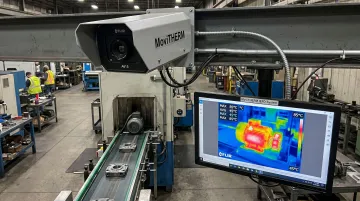
Those specs translate to practical coverage: a single camera can monitor large industrial floor areas for early-stage hotspots that smoke or heat detectors would miss entirely. Thermal imaging complements rather than replaces code-required detectors — it adds an earlier warning layer for scenarios where traditional technologies would respond too late or generate too many false alarms.
Key Components of a Fixed Fire Detection System
Every component in a fixed detection system must be approved for its specific hazard class per 29 CFR 1910.160(b)(1). The system is only as reliable as its weakest link.
Detectors and Sensors
Detectors form the sensing layer: they identify a fire signature and send a signal to the control panel. Placement matters as much as technology selection. Ceiling height, airflow patterns, obstructions, and occupancy type all affect how detectors should be spaced and positioned.
For thermal camera systems, protective enclosures are essential for continuous performance in harsh environments. MoviTHERM's IP66/IP67-rated anodized aluminum enclosures and IP69K-rated stainless steel (A316L) units protect cameras against dust, moisture, washdown conditions, and vibration.
Fire Alarm Control Panel (FACP)
The FACP is the system's central processor. It receives signals from all initiating devices, processes them, and triggers appropriate outputs:
- Audible and visual notification appliances
- Suppression system activation
- HVAC shutdown
- Transmission to monitoring stations or emergency responders
Modern panels support zone-based monitoring, allowing a triggered detector to be localized quickly without requiring facility-wide evacuation for a contained event.
Alarm and Notification Devices
Under OSHA 29 CFR 1910.165, alarms must be perceivable above ambient noise and light levels by all employees in the affected area. Audible alarms (sirens, horns), visual alarms (strobes), and digital notifications each serve specific occupancy needs. For total-flooding suppression-integrated systems, a pre-discharge alarm is mandatory before agent release, giving workers time to evacuate safely.
Monitoring and Remote Alert Integration
Local alarms handle on-site notification — but when a facility operates across shifts, sites, or US time zones, remote visibility becomes equally critical. MoviTHERM's iTL (Intelligent Thermal Locator) platform addresses this with a hybrid architecture: local iTL Gateways process and log alarm data on-site, functioning even without internet connectivity. iTL Studio extends that coverage to the cloud, secured via AWS 2048-bit encryption.
Engineering teams and EHS leaders can access remotely:
- IR image snapshots with history scroll
- Temperature measurement and trend data
- Customizable dashboards with alarm summary tables
- Facility CAD overlays showing sensor and camera status
- Scheduled compliance reports (daily, weekly, monthly) via email
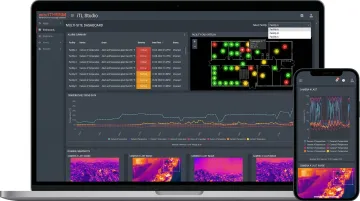
Alert delivery includes text, email, and voice calls through a virtual auto-dialer — ensuring the right people are notified the moment a threshold is breached.
Backup Power Supply
NFPA 72 (2025 edition) requires two independent power sources. The secondary source must provide:
- 24 hours of standby operation under maximum quiescent load
- 5 minutes of full alarm operation after the standby period (15 minutes for voice/alarm communication systems)
- Automatic switchover within 10 seconds of primary power failure
Battery maintenance is safety-critical. NFPA 72 Table 14.4.3.2 requires semi-annual testing for lead-acid batteries — skipping that schedule means your backup may fail precisely when you need it most.
Fixed Fire Detection System Standards and Compliance
Compliance operates on two layers: OSHA sets mandatory workplace requirements; NFPA standards provide the engineering benchmarks that satisfy them. Meeting NFPA's prescriptive schedule generally satisfies OSHA's performance-based language, but the reverse is not true.
Key OSHA Standards
29 CFR 1910.164 (Fire Detection Systems) is the primary standard for automatic detection:
- All equipment must be approved for its intended purpose
- Systems must be restored to normal operating condition as promptly as possible after each test or alarm
- Maintenance and testing must be performed by a trained, knowledgeable person
- Detectors must be cleaned of particulates at regular intervals
- Alarm delays for suppression-integrated systems shall not exceed 30 seconds
29 CFR 1910.160 (Fixed Extinguishing Systems) applies when detection integrates with suppression:
- Agent storage containers checked semi-annually (weight/pressure loss >5% or >10% respectively triggers maintenance)
- Annual inspection by a knowledgeable person
- Pre-discharge alarm required for total-flooding systems
Key NFPA Standards
NFPA 72 (2025 edition) is the foundational design standard covering installation, performance, inspection, testing, and maintenance of fire alarm and detection systems. All facilities must verify compliance against the current edition.
Application-specific standards apply when detection integrates with suppression:
| Standard | Suppression Type | Current Edition |
|---|---|---|
| NFPA 12 | CO₂ systems | 2025 |
| NFPA 2001 | Clean agent systems | 2025 |
| NFPA 750 | Water mist systems | 2027 |
| NFPA 17 | Dry chemical systems | 2024 |
| NFPA 17A | Wet chemical systems | 2021 |
Sector-specific references to consult alongside NFPA standards:
- API RP 2001 (10th Edition, October 2024) — refinery and oil and gas fire protection
- FM Global Data Sheet 5-48 — automatic fire detection for high-value facilities
- FM Global DS 5-32 — data center-specific fire protection guidance
Testing, Maintenance, and Best Practices
OSHA's performance-based language in 1910.164 — "as often as needed" — is best interpreted through NFPA 72's specific testing intervals. Defaulting to NFPA 72's schedule is the safest compliance baseline.
NFPA 72 testing intervals by component:
| Component | Frequency |
|---|---|
| Flame (radiant energy) detectors | Quarterly |
| Waterflow devices | Quarterly |
| Lead-acid batteries | Semi-annual |
| Smoke detectors | Annual |
| Heat detectors | Annual |
| FACP functions | Annual |
| Notification appliances | Annual |
| Primary power supply | Annual |
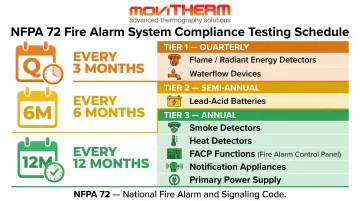
A single "annual inspection" schedule is not sufficient for full NFPA 72 compliance. Flame detectors and batteries require more frequent attention.
Beyond testing schedules, two distinct personnel obligations apply to fixed fire detection systems:
- Training (1910.160(b)(10)): Employees who inspect, maintain, or operate fixed systems must receive documented training with annual review.
- Qualified service personnel (1910.164(c)(4)): Anyone servicing detection equipment must be knowledgeable in that specific system's operations.
These are separate requirements — both apply, and both must be documented.
Record-keeping is both a compliance requirement and a liability tool. Inspection dates, test results, and maintenance actions must be logged and retained.
Cloud-based monitoring platforms like MoviTHERM's iTL Studio automate much of this documentation. Timestamped alarm logs, temperature trend histories, and scheduled reports are generated without manual data entry, reducing the compliance burden on facility teams.
Frequently Asked Questions
What is a fixed fire protection system?
A fixed fire protection system is a permanently installed network designed to detect and/or suppress fire automatically. It encompasses detection-only systems (sensors, control panels, alarms) and integrated detection-suppression systems (sprinklers, gas agents). Both categories operate without manual activation.
What are the two types of fire detection systems?
Fire detection systems fall into two broad categories: automatic systems (smoke, heat, and flame detectors that trigger without human input) and manual systems (pull stations or break-glass call points requiring a person to activate them). Most modern fixed installations combine both, with automatic detection for continuous coverage and manual stations as backup.
What is the difference between a fire detection system and a fire suppression system?
A detection system identifies fire conditions and triggers alarms. A suppression system actively extinguishes or controls the fire using water, gas, foam, or chemicals. The two are frequently integrated but governed by separate OSHA standards: 29 CFR 1910.164 for detection, 29 CFR 1910.160 for fixed extinguishing systems.
What standards apply to fixed fire detection systems in industrial workplaces?
The primary standards are OSHA 29 CFR 1910.164 (detection systems), OSHA 29 CFR 1910.160 (fixed extinguishing systems), and NFPA 72 (National Fire Alarm and Signaling Code, 2025 edition). Agent-specific NFPA codes and industry standards such as API RP 2001 and FM Global data sheets may also apply.
How often should fixed fire detection systems be inspected and tested?
OSHA requires maintenance sufficient to keep systems operational, with no fixed calendar interval prescribed under 1910.164. NFPA 72 is more specific: flame detectors require quarterly testing, batteries semi-annual, and most other components annual. Agent storage containers in suppression-integrated systems require semi-annual weight and pressure checks under 29 CFR 1910.160.