Introduction
Data centers run continuously under extreme thermal and electrical stress — and the financial consequences of failure are severe. According to the Ponemon Institute, the average cost of a single unplanned data center outage reaches $740,357, with per-minute costs hitting $8,851. Power-related failures account for 44% of all significant outages, with UPS failures alone responsible for 25% of incidents.
Most facilities already have sensors, alarms, and maintenance schedules. The gap isn't coverage — it's timing. Electrical faults build gradually through insulation degradation, contact wear, and thermal stress, often staying invisible until long after a scheduled inspection window has passed.
American operations teams are moving to continuous, real-time asset monitoring — catching degradation as it develops rather than waiting for the next scheduled window. This post covers what that shift actually requires: which assets need continuous visibility, how thermal imaging fills the detection gap, and what a practical monitoring strategy looks like at scale.
Key Takeaways
- Real-time monitoring gives data center teams continuous visibility into thermal, electrical, and environmental conditions — enabling planned interventions instead of emergency responses.
- Power infrastructure (UPS systems, switchgear, PDUs, transformers) produces detectable heat signatures long before visible failure.
- Thermal imaging cameras catch hot spots without contact, without shutdowns, and far faster than manual inspection methods.
- Automated alerts tied to live thermal data let teams act before failures cascade — protecting uptime and redundancy.
Why Real-Time Monitoring Has Become Non-Negotiable
The Problem with Scheduled Inspections
Traditional monitoring relies on periodic manual walk-throughs, scheduled thermographic surveys, and static sensor alarms. The fundamental flaw: electrical faults rarely respect inspection schedules.
Most failures develop over weeks or months through:
- Insulation breakdown from thermal cycling
- Loose connections generating resistive heating
- Overloaded circuits operating near rated capacity
- Capacitor degradation in UPS systems
A quarterly inspection captures conditions at one moment. Everything between visits — load spikes, gradual contact wear, thermal creep — goes undetected. That gap is where failures originate.
Modern Data Centers Have Outgrown Static Monitoring
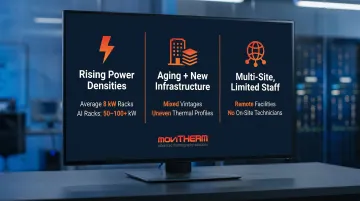
Three structural shifts have turned continuous monitoring from a nice-to-have into a baseline requirement:
- Rising power densities — Uptime Institute's 2024 Global Data Center Survey reports average rack densities approaching 8 kW, with AI-driven racks pushing toward 50–100+ kW. Higher current loads compress the time window between detectable anomaly and failure.
- Aging infrastructure alongside new expansions — mixed vintages create uneven thermal profiles that point sensors often miss.
- Multi-site operations with limited on-site staff — facilities can't rely on human walk-throughs when technicians aren't physically present.
The Redundancy Risk
Even highly resilient facilities fail when degradation quietly erodes redundancy margins. Cloudflare's Portland facility suffered two complete power failures within four months — November 2023 and March 2024 — with the first triggering a 72-hour cold start recovery across more than 100 databases.
That the failure recurred at the same site points to an underlying electrical condition that wasn't fully characterized after the first event. The secondary system appeared healthy on paper while the primary continued to degrade. Continuous monitoring exists precisely to surface that kind of slow-moving, invisible deterioration before it becomes the next outage.
What Assets Require Real-Time Monitoring in a Data Center
Effective coverage spans three distinct layers, each with different failure modes and risk profiles.
Electrical Infrastructure (Highest Priority)
This is where 44% of data center outages originate. Every asset in the power chain should be considered a primary monitoring target:
- UPS systems — the single largest cause of unplanned outages (25%), containing capacitor banks, rectifiers, and connection points that all produce thermal signatures during degradation
- Transformers and switchgear — high-load switching equipment where loose connections and overloaded conductors generate heat long before tripping
- Power distribution units (PDUs) — rack-level distribution points where overcurrent conditions develop gradually
- Circuit breakers — contact wear produces detectable thermal asymmetry across phases before mechanical failure
IT Infrastructure
Server and networking equipment present a different challenge: rack-level thermal management. As power densities increase, localized overheating within a rack can degrade hardware performance before any alarm triggers.
Hot spots in networking equipment — switches, routers, and storage arrays — tend to develop at connection points and cooling intake zones. Traditional temperature sensors placed at the row level fail to detect these localized signatures entirely.
Environmental Conditions
Ambient temperature, humidity, and airflow across hot and cold aisles directly affect electrical stress. A hot aisle that runs 5°C above design spec accelerates degradation across every piece of equipment in that zone. Environmental data gives thermal anomalies meaning — without it, a temperature spike in a rack could reflect a cooling failure, a power surge, or simply a blocked vent. Context determines the correct response.
How Thermal Imaging Catches What Other Monitoring Systems Miss
What Thermal Cameras Actually Detect
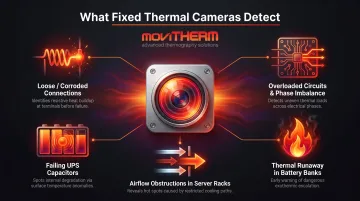
Fixed infrared cameras measure surface temperature distributions across an entire field of view, continuously. In a data center electrical room, that means detecting:
- Loose or corroded connection points generating resistive heat
- Overloaded circuits with thermal imbalances across phases
- Failing capacitors in UPS systems showing localized hot spots
- Thermal runaway conditions developing in battery banks
- Airflow obstructions creating hot zones in server infrastructure
The key distinction from point sensors: a thermocouple or RTD measures temperature at its exact contact location only. A hot spot developing 15 centimeters away on an adjacent connection — different phase, different terminal — goes completely undetected until it becomes a failure.
Fixed Cameras vs. Periodic Handheld Surveys
| Monitoring Method | Spatial Coverage | Temporal Coverage | Requires Shutdown? |
|---|---|---|---|
| Point sensors | Single contact point | Continuous | No |
| Periodic handheld IR | Wide-area | Snapshot only | No |
| Fixed-mount thermal cameras | Wide-area | Continuous, 24/7 | No |
Handheld thermographic surveys capture conditions at the moment the technician is present. A fault that develops between surveys — or that only manifests under peak load conditions at 2 AM — will never appear in that data. Fixed cameras eliminate this temporal gap entirely.
Thermal inspection also runs substantially faster than contact-based methods. MoviTHERM documents infrared inspection improving inspection time 8 to 10 times compared to ultrasound — validated by NDT professionals who previously relied on ultrasound for large-surface-area work. No physical contact, no gels or couplants, no ionizing radiation, and no equipment shutdown required.
The MoviTHERM Approach
MoviTHERM's integrated thermal monitoring systems pair fixed infrared cameras from FLIR and Optris with the proprietary iTL cloud monitoring platform, built for continuous infrastructure surveillance. Key platform capabilities include:
- 24/7 automated alerts via text, voice, and email
- 240 configurable alarm thresholds to match facility-specific risk tolerances
- Remote access to live thermal images and trend data from any internet-connected device
- Protocol integration via Modbus/TCP, MQTT, and RESTful API for connection to existing DCIM or BMS platforms
- Multi-site portfolio views that aggregate thermal data across facilities without requiring on-site staff at every location
Key Operational Benefits of Real-Time Asset Monitoring
Earlier Fault Detection, Fewer Emergency Responses
Catching a thermal anomaly at the degradation stage — before it becomes a failure — converts what would have been an emergency into a scheduled maintenance window. Deloitte's predictive maintenance research reports that condition-based approaches reduce equipment breakdowns by 70% and increase productivity by 25% compared to reactive strategies. For data centers, where the average outage costs $740,357, continuous monitoring doesn't take long to justify its cost.
Redundancy Preservation
Early detection matters most when redundancy is at stake. Many critical electrical failures aren't caused by a single catastrophic event — they happen when degradation erodes redundancy margins before the operations team notices. By the time the primary system fails, the backup is already compromised. Real-time thermal visibility lets teams address degrading components while redundancy is still fully intact, not after it's already degraded.
Maintenance Efficiency
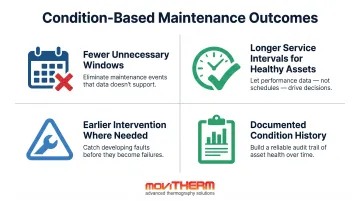
Condition-based maintenance replaces time-based schedules. Instead of inspecting every UPS bank quarterly regardless of actual condition, teams direct attention to assets showing genuine thermal trends. That means:
- Fewer unnecessary maintenance windows
- Longer service intervals for healthy equipment
- Earlier intervention on assets that actually need it
- Documented condition history that supports audit and procurement decisions
Compliance and Audit Readiness
The 2023 revision of NFPA 70B, the U.S. standard governing electrical maintenance, elevated thermographic inspection from recommended practice to a mandatory standard, requiring documented IR inspection of all electrical equipment at intervals not exceeding 12 months — and every 6 months for Condition 3 (degraded) equipment.
Continuous fixed-camera monitoring exceeds this regulatory floor and generates an automatic documented record of thermal conditions over time, supporting compliance audits and executive risk reporting with quantitative data.
Building a Scalable Real-Time Monitoring Strategy
Start with Coverage Design
Not every asset carries equal risk. Start by mapping the power chain — transformers, main switchgear, UPS systems, PDUs — and flagging any high-density server zones with elevated thermal profiles. These are your monitoring priorities.
Camera placement should ensure no critical asset sits in a coverage blind spot. Cameras need full-surface thermal views of connection points, busbars, and phase conductors — not just ambient area readings.
MoviTHERM's engineering team provides consultation on camera selection, lens choice, and mounting distance — factors that determine whether a system actually detects what it's supposed to detect, rather than leaving detection gaps at critical angles.
Centralize the Data
Real-time monitoring generates continuous thermal data streams across multiple camera feeds. That data only delivers value when it flows into a centralized platform that:
- Aggregates thermal, environmental, and electrical health metrics in one view
- Surfaces anomalies automatically rather than requiring manual image review
- Makes trends accessible across sites without requiring local staff
MoviTHERM's iTL cloud platform is built for exactly this integration layer. Its multi-site Facility View and Maps View allow portfolio-level oversight of distributed data centers from a single dashboard, with no on-site presence required.
Manage Alert Fatigue Deliberately
Centralizing all that data into one platform also means a higher volume of potential alerts. A system that generates constant noise trains operators to ignore it — so effective alert configuration matters as much as coverage design. The goal is distinguishing real warning conditions from normal operational variation.
The iTL platform supports this through:
- 240 configurable Above/Below threshold alarms per deployment
- Customizable alarm severity levels and notification schedules
- Multi-recipient alert routing with tiered escalation logic
- Thermal-based triggering (not motion or smoke) that keeps false positive rates low
When alerts are configured correctly, operators engage with them. That responsiveness is what converts monitoring data into prevented failures.
Frequently Asked Questions
What platforms are best for real-time data center asset monitoring?
The strongest approaches integrate thermal imaging data, environmental sensor readings, and electrical health metrics into a single platform with automated alerting, rather than managing separate DCIM software, point sensor dashboards, and inspection logs. Cloud-based platforms like MoviTHERM's iTL — combined with DCIM or BMS integration via Modbus/TCP or REST API — provide this unified view in a single interface.
What assets should be monitored in real time in a data center?
The three primary layers are electrical infrastructure (UPS systems, transformers, PDUs), IT equipment (servers, storage arrays, networking gear), and environmental conditions (temperature, humidity, airflow). Start with the power chain: power failures account for 44% of significant outages, making electrical and thermal monitoring the highest-priority investment.
How does thermal imaging detect equipment failures before they occur?
Thermal cameras continuously measure surface heat signatures across their full field of view. Loose connections, overloaded circuits, and failing components generate detectable heat anomalies long before physical damage occurs or conventional alarms trigger , giving operators time to intervene during a planned maintenance window rather than an emergency.
What is the difference between reactive and predictive asset monitoring?
Reactive monitoring responds to alarms after a fault has already developed. Predictive monitoring uses continuous data (thermal trends, for example) to detect degradation early, shifting the team's role from emergency response to planned, risk-based maintenance. Reactive failures cost an average of $740,357 per incident — a figure that makes the case for predictive approaches plainly.
Can thermal cameras monitor data center equipment without interrupting operations?
Fixed thermal cameras perform continuous, non-contact monitoring of live equipment with no shutdowns, no physical access to energized components, and no gels or couplants required. This makes them uniquely suited to 24/7 data center environments where taking equipment offline for inspection isn't practical.
How often should data center electrical assets be inspected?
NFPA 70B 2023, the United States electrical maintenance standard, now mandates thermographic inspection at intervals not exceeding 12 months, with 6-month intervals for degraded equipment. Continuous fixed-camera monitoring eliminates the gaps between these scheduled surveys entirely , catching transient faults and load-dependent conditions that only appear between scheduled inspection windows.