Introduction
Approximately 15% of underground coal mine fires during 1978–1990 were caused by spontaneous combustion, while in China, this figure climbs dramatically to 90–94% of all mine fire events. These statistics carry real financial weight: direct economic losses in China exceed $280 million annually, and a single U.S. coal bunker explosion in 1991 caused $4 million in damage.
Production shutdowns, equipment destruction, environmental fines, and worker injury risk near storage yards are the operational consequences facilities face when spontaneous combustion goes undetected.
What makes coal spontaneous combustion particularly dangerous is that it develops without any visible ignition source, progressing invisibly below the pile's surface. By the time smoke appears, temperatures may already exceed 80–120°C — well past the point of easy intervention. Continuous thermal monitoring addresses this directly, providing around-the-clock visibility into subsurface heat buildup so facilities can act before conditions escalate.
Key Takeaways
- Coal undergoes low-temperature oxidation immediately upon air exposure, making every stockpile a spontaneous combustion risk.
- Thermal runaway occurs at 80–120°C—by the time visible smoke appears, the fire is already beyond easy control.
- Visual surface inspection misses subsurface heat buildup — continuous thermal imaging catches anomalies before they escalate.
- Continuous automated monitoring eliminates dangerous detection gaps that periodic manual inspections leave exposed.
- Top monitoring failures: periodic manual checks, poor camera placement, and overlooking slow-rising temperature trends.
The Fire Risk of Coal Stockpiles: Why Temperature Monitoring Is Critical
Coal spontaneous combustion begins the moment freshly mined coal contacts oxygen. The resulting exothermic reaction releases heat that accumulates in the pile's interior, particularly in zones with moderate airflow where heat cannot dissipate quickly.
Coal acts as a good insulator, meaning deep-seated fires may not produce high exterior surface temperatures. Dangerous conditions can develop and advance well before anything visible appears at the surface.
The Three Progressive Stages of Coal Self-Heating
Understanding the staged progression of coal self-heating is essential for effective monitoring:
Slow oxidation (ambient to ~60°C): Initial heat accumulation begins as oxygen contacts coal surfaces. CO emission rate starts to increase rapidly above 60°C.
Accelerated oxidation (60–120°C): Heat production outpaces dissipation. Research shows critical temperatures near 85°C and 110–138°C vary by coal rank.
Thermal runaway (above ~120°C): Self-sustaining combustion begins, and external intervention becomes extremely difficult.
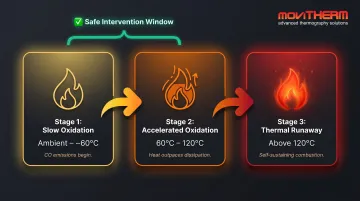
The window for safe intervention exists only in the first two stages. Once thermal runaway begins, the fire is already established.
Why Coal Stockpiles Are Structurally Prone to Hidden Fire Development
Several structural factors make stockpiles particularly vulnerable:
- Bulk material insulation traps heat internally, allowing subsurface temperatures to climb significantly higher than surface readings
- Hot spots typically form about 2 meters in from pile sides where oxygen penetration and heat accumulation balance
- Fine particle concentration increases surface area available for oxidation reactions
- Moisture variation creates complex effects (discussed in detail below)
- Wind-assisted oxygen ingress accelerates oxidation in certain pile geometries
Laboratory research confirms that distributed temperature measurement on self-burning coal waste piles found internal temperatures exceeding 90°C while surface temperatures remained near ambient levels of 22–26.6°C—a clear demonstration of how surface conditions mask subsurface danger.
Operational Consequences of Undetected Stockpile Fires
The operational costs extend far beyond coal volume loss:
- Explosion risk from CO and methane buildup: Low molecular weight hydrocarbons accumulate during oxidation, creating explosive atmospheres (a 2009 explosion at We Energies' Oak Creek plant injured five workers, four critically)
- Emergency shutdown costs: Unplanned downtime disrupts production schedules and contract obligations.
- Equipment destruction: NIOSH documented 51 fires that destroyed or heavily damaged equipment across U.S. coal operations during 1990–1999.
- Regulatory penalties: Environmental agencies impose substantial fines for air quality violations and uncontrolled combustion events.
- Reputational damage: Facilities with fire incidents face increased insurance premiums and scrutiny from regulators and customers.
These consequences share a common thread: they are largely preventable when subsurface temperature anomalies are detected early. That's where sensor placement strategy, alarm thresholds, and continuous monitoring coverage become the deciding factors.
Safety Guidelines for Coal Stockpile Temperature Monitoring
Safe temperature monitoring of coal stockpiles requires both physical safety discipline around the pile environment and operational discipline in how monitoring data is interpreted and acted upon. Neither replaces the other.
General Safety Precautions
Baseline safety rules apply whenever personnel are present near a monitored coal pile:
- Establish and enforce exclusion zones around any pile showing elevated temperatures
- Require CO gas monitoring for any personnel entering high-temperature zones
- Mandate temperature data review before any inspection or intervention occurs near a pile
Thermal imaging results must be reviewed by trained personnel who understand emissivity, reflectivity, and ambient temperature influences on infrared readings. Raw data should never trigger unverified physical intervention near an at-risk pile.
Safety During Monitoring System Installation
Site preparation and placement decisions determine whether a system will be effective:
- Position cameras for full surface coverage without blind spots
- Mount at angles that account for pile geometry to capture all critical zones
- **Install in weatherproof housings** rated for the environmental conditions at the site
Mounting height and angle considerations:
- Too far from pile surface reduces spatial resolution and ability to detect small hot spots early
- Too close risks lens contamination from coal dust, requiring regular cleaning protocols built into the maintenance plan
Monitoring systems should never substitute for pile management practices. Compaction, turnover schedules, and storage duration limits must remain in place alongside monitoring infrastructure — and those same operational habits carry over into how teams respond once the system is live.
Safety While Operating and Responding to Alerts
Setting appropriate alarm thresholds:
Thresholds should be calibrated to the specific coal grade stored and ambient operating temperature range. Overly conservative thresholds generate false alarms that lead to alarm fatigue, while thresholds set too high give operators insufficient response time before conditions become dangerous.
Behavioral risks that undermine operational safety:
- Assuming stable temperature trends mean no risk is developing: Even stable elevated temperatures indicate active oxidation
- Delaying response to alerts pending manual confirmation: Hours matter when conditions are escalating
- Bypassing automated alarms during high-production periods: Production pressure should never override safety protocols
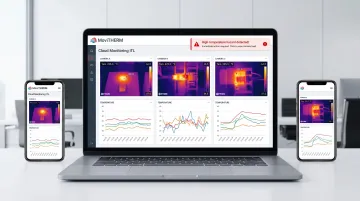
MoviTHERM's iTL cloud monitoring platform is built for exactly this operational context. It delivers 24/7 remote access to thermal images and trend data, automated alerts via text, voice, and email, and direct integration with fixed thermal cameras from FLIR and Optris — so teams can act on temperature data well before conditions require emergency response.
Environmental and System Safety Considerations
External conditions significantly affect thermal readings and monitoring reliability:
Solar radiation effects: Direct solar loading can individually increase surface temperatures by 5.5–6.3°C under the same environmental conditions, potentially masking or mimicking hot spots. Timing thermal inspections to account for sun incidence angle helps avoid misleading readings.
Wind direction and airflow: Research demonstrates that pile slope creates wind resistance, forcing air into the pile. Spontaneous combustion typically occurs on the windward side where oxygen supply increases. Laboratory studies confirm that peak temperature rise occurs at an optimum ventilation flow: too much airflow removes heat by convection, while too little limits oxygen supply and slows the reaction.
Moisture paradox: Moisture creates complex, counterintuitive effects on self-heating:
- Evaporation extracts heat and initially suppresses temperature increase in early stages
- Exothermic "heat of wetting" when moist air contacts dry coal releases approximately 2,261 J/kg H₂O, increasing temperature and enhancing self-heating
- After local moisture evaporates, self-heating proceeds rapidly
Particle-scale research confirms that higher moisture delays initial heating due to latent heat, but after drying, concentrated volatile release increases homogeneous ignition probability and accelerates heating.
System performance must be verified after major weather events, dust accumulation periods, and pile geometry changes. Coverage and calibration valid at installation may no longer be valid after the pile has been replenished, turned, or partially consumed.
Common Safety Mistakes to Avoid
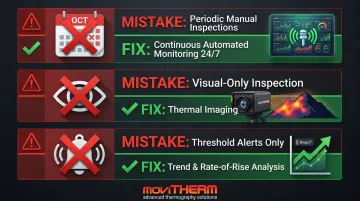
Three recurring mistakes consistently put coal storage operations at risk:
Replacing continuous monitoring with periodic manual inspections. Hot spots can take months to appear within a pile, meaning sporadic checks leave dangerous gaps. Temperatures can escalate from slow oxidation into thermal runaway between visits. Manual inspections serve as a supplement to continuous monitoring, not a substitute for it.
Treating no visible smoke or odor as proof of safe conditions. Spontaneous combustion develops internally before any surface signs appear. Operations that rely on visual checks alone routinely report being blindsided by sudden fire events — precisely because the hazard was invisible until it wasn't.
Relying on threshold alarms instead of trend analysis. A pile rising 2–3°C per day over two weeks may never trigger a single high-temperature alarm, yet a combustion event is already developing. Research confirms that temperature changes in large-scale coal stockpiles are slow and require extended monitoring to detect. Effective programs combine rate-of-rise tracking with trend analysis — peak temperature alerts alone are not enough.
Conclusion
Coal stockpile fire prevention depends on treating temperature monitoring as a continuous, system-level safety practice, not a one-time installation task. Monitoring infrastructure, response protocols, personnel training, and pile management disciplines must all be maintained together — and each one depends on the others holding up.
Operations teams should evaluate whether their current monitoring setup covers the basics:
- Full thermal coverage across the entire pile surface, including edges and interiors
- Real-time alerting with defined temperature thresholds and escalation paths
- Documented response workflows that personnel have reviewed and practiced
- Regular calibration checks to confirm sensors are reading accurately
Any gap in those areas is an active risk, not a backlog item.
If your team is designing or reassessing a coal stockpile monitoring system, MoviTHERM provides complete thermal monitoring solutions — fixed cameras, protective enclosures, and cloud-based alerting — built for continuous industrial operation. Reach out to discuss coverage design and system configuration for your site.
Frequently Asked Questions
At what temperature does coal spontaneous combustion become a serious risk?
Risk develops in stages: CO emissions accelerate above 60°C, accelerated oxidation begins around 80°C, and thermal runaway can occur between 80–120°C depending on coal rank. Any reading above ambient temperature warrants continuous tracking to catch developing trends early.
How often should coal stockpile temperatures be monitored?
Continuous automated monitoring is the industry standard for active stockpiles, because temperature conditions can change within hours. Periodic manual checks leave dangerous gaps in detection coverage where oxidation can accelerate undetected.
Can thermal imaging cameras detect fires developing inside a coal pile, not just on the surface?
Thermal cameras detect surface temperature anomalies — the most practical early indicator of subsurface heating. For confirmed subsurface fires, borehole temperature sensors or CO gas monitoring are typically used alongside surface thermal imaging.
What should you do when a hot spot is detected in a coal pile?
Response protocols should be in place before any alert fires. Typical steps include confirming the reading with a secondary check, assessing CO gas levels, notifying safety personnel, and initiating intervention — water application or material relocation. Never approach a high-temperature zone without proper PPE and gas monitoring equipment.
How do wind and moisture affect coal stockpile fire risk?
Wind accelerates oxidation by increasing oxygen supply to interior pile zones, with fires typically initiating on the windward side. Moisture is more complex: it initially suppresses surface temperatures but promotes heat-generating microbial activity. Drying events after moisture infiltration have been linked to rapid temperature spikes.
What is the difference between thermal imaging and gas detection for coal stockpile monitoring?
Thermal imaging provides spatial, real-time surface temperature maps across large pile areas and is effective for early hot spot identification. Gas detection (CO monitoring in particular) provides a chemical indicator of active oxidation chemistry. Both methods have complementary roles and are most effective when used together in high-risk storage environments.