

Introduction
Unplanned equipment failures cost industrial manufacturers an estimated $50 billion annually in the United States alone, according to Deloitte Insights research on predictive maintenance. Poor maintenance strategies can erode 5% to 20% of a plant's productive capacity — and when something breaks unexpectedly, emergency repairs typically run three to five times more than planned work.
Despite those numbers, 61% of maintenance professionals still rely on reactive, run-to-failure methods. That gap is expensive — and it's largely preventable.
This guide gives facility managers, plant operators, and maintenance engineers a clear, practical breakdown of IoT-enabled predictive maintenance — what it is, how it works, and how to start building a case for it.
Key Takeaways
- Unplanned downtime costs US manufacturers $50B annually — IoT-enabled predictive maintenance targets this directly
- Predictive maintenance uses AI to forecast failures before they happen, unlike time-based or condition-based approaches
- Four pillars drive it: connected sensors, data communication, centralized storage, and predictive analytics
- Core sensor types: vibration, temperature, thermal/infrared, acoustic emission, and electrical current
- Proven outcomes include fewer unplanned outages, lower repair costs, longer asset life, and reduced safety incidents
What Is IoT-Enabled Predictive Maintenance?
IoT-enabled predictive maintenance uses a network of connected sensors, devices, and software to continuously collect and analyze equipment data — so teams can predict failures before they occur rather than respond after the fact.
The Internet of Things refers to physical devices that communicate data over the internet, creating a self-reporting equipment ecosystem. In industrial settings, sensors embedded in or attached to machines transmit performance data continuously to centralized platforms where analytics run in real time.
Maintenance Strategy Comparison: TBM, CBM, and PdM
Three distinct strategies exist, and understanding the differences explains why predictive maintenance is attracting growing investment.
| Strategy | Trigger | Limitation |
|---|---|---|
| Time-Based Maintenance (TBM) | Fixed calendar or run-hour schedule | Replaces parts that still have useful life; can miss emerging faults between intervals |
| Condition-Based Maintenance (CBM) | Sensor threshold breach (e.g., vibration exceeds X) | More efficient than TBM, but reacts to the present state — not the future |
| Predictive Maintenance (PdM) | AI-forecast failure window | Requires data maturity and ML model integration to implement effectively |
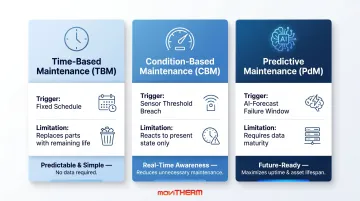
Predictive maintenance is technically a data-driven subset of CBM. The critical distinction: CBM tells you a problem exists now, while PdM tells you a problem is coming — and when. That difference determines whether you schedule a repair during a planned production window or scramble during an unscheduled shutdown.
IoT infrastructure is what makes true PdM possible at scale. Without continuous, real-time data streams from connected devices, there's nothing meaningful for AI to analyze.
How IoT-Enabled Predictive Maintenance Works: The Four Core Pillars
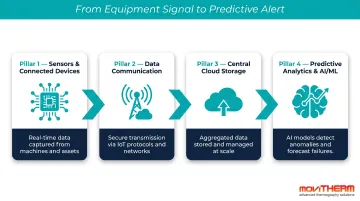
The data flow follows a logical path: sensors capture equipment behavior → data travels to centralized systems → analytics process the data → maintenance teams receive actionable alerts. Four pillars support that path.
Pillar 1: Sensors and Connected Devices
Sensors are the foundation. Embedded in or attached to equipment, they continuously measure parameters like temperature, vibration, pressure, and electrical current — converting physical machine behavior into digital data streams. Without this layer, there's nothing to analyze.
Pillar 2: Data Communication
Captured data travels from sensors to centralized systems via protocols such as Wi-Fi, Bluetooth, Ethernet, cellular (4G/5G), and LPWAN technologies like LoRaWAN. Industrial-grade wireless standards including WirelessHART and ISA100.11a are commonly used in process industries and hazardous environments.
Edge computing shifts data processing to the device or gateway level — cutting latency, filtering noise before cloud transmission, and keeping critical alarm functions running even when the network drops. Siemens, for example, has deployed edge AI systems capable of predicting bearing failures up to three weeks in advance by processing sensor data at the factory floor rather than routing everything to the cloud.
MoviTHERM's iTL Gateway follows the same logic: it processes thermal camera data locally, triggers alarms immediately on threshold breach, and runs independently of cloud connectivity. Safety-critical alerts don't wait on internet latency.
Pillar 3: Central Data Storage
Where edge handles speed and resilience, the cloud handles scale. Cloud-based platforms aggregate data from all monitored assets, giving analytics teams access from anywhere — while keeping that data secured against the compliance and breach risks that come with industrial deployments. Relevant standards include ISA/IEC 62443 (the primary framework for securing IIoT sensor networks), NIST 800-82, and ISO/IEC 27400:2022 for IoT-specific device authentication and data integrity. The iTL cloud platform uses AWS 2048-bit encryption and encrypted VPN for remote access.
Pillar 4: Predictive Analytics and AI/ML
Machine learning algorithms analyze historical and real-time data to identify anomalous patterns, establish health baselines for each asset, and generate failure predictions with estimated time-to-failure. Outputs feed into CMMS platforms to auto-generate work orders, prioritize repair schedules, and document maintenance history — turning raw sensor readings into scheduled action.
IoT Sensors and Devices Used in Predictive Maintenance
Sensor selection determines which failure modes get detected. Modern deployments combine multiple sensor types for a more complete picture of equipment health.
Vibration Sensors
Vibration sensors detect mechanical irregularities in rotating equipment — motors, pumps, bearings, and gearboxes. By analyzing oscillation frequency and amplitude patterns, they identify imbalance, misalignment, looseness, and bearing defects at early stages.
Two primary technologies exist:
- Piezoelectric sensors — wide frequency response (0.5 Hz to 10+ kHz), high resolution, preferred for high-value machinery like turbines and compressors
- MEMS accelerometers — lower cost, suited for high-volume smaller machinery like conveyor belts and machine tools
Temperature Sensors and Thermal Cameras
Temperature monitoring catches overheating components before they fail. Point-contact and thermocouple sensors measure individual spots effectively, but they can't see what they're not pointed at.
Thermal/infrared cameras solve that problem directly. A single fixed unit scans entire machines, electrical panels, or conveyor systems in real time, detecting hot spots invisible to standard sensors and often invisible to the human eye until it's too late.
Fixed continuous thermal monitoring systems take this further. MoviTHERM's iTL platform provides 24/7 cloud-based thermal surveillance with automated alerts via text, voice, and email — enabling remote anomaly detection without physical inspections.
Compatible cameras like the FLIR A50/A70 and A400/A700 series continuously stream radiometric data with accuracy of ±2°C. Temperature ranges extend from -20°C up to 2,000°C depending on the model, covering everything from bearing monitoring to high-temperature furnace and process equipment.
The broader thermal imaging market reflects growing adoption: valued at approximately $4.5–5.0 billion in 2024 and projected to reach $13.5–15.5 billion by 2036, driven substantially by industrial condition monitoring demand.
Acoustic Emission and Electrical Current Sensors
Acoustic emission (AE) sensors detect high-frequency elastic waves from microscopic material changes — cracks, corrosion, friction — at the material level. Unlike vibration analysis, which picks up existing mechanical forces, AE monitoring captures energy released from defects before mechanical symptoms appear.
That distinction matters. AE sensors are particularly valuable for catching bearing wear and structural fatigue at the earliest possible stage — often weeks before any vibration signature develops.
Electrical current sensors monitor motor power draw, voltage fluctuations, and current imbalances through a technique called motor current signature analysis (MCSA). Deviations from baseline electrical patterns signal developing motor faults, overload conditions, or efficiency degradation — often without requiring physical access to the motor.
Key Benefits of IoT-Enabled Predictive Maintenance
Reduced Downtime and Maintenance Costs
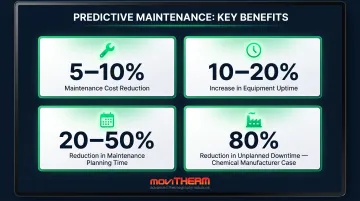
Detecting issues early means scheduling repairs during planned windows rather than reacting to emergency failures. According to Deloitte's research on predictive maintenance, PdM delivers:
- 5–10% reduction in maintenance costs
- 10–20% increase in equipment uptime
- 20–50% reduction in maintenance planning time
Real-world results validate the range. A chemical manufacturer achieved an 80% reduction in unplanned downtime, saving $300,000 per asset. Trenitalia reduced its $1.3 billion annual maintenance budget by 8–10%, saving approximately $100 million per year.
Extended Asset Life and Optimized Resource Allocation
Addressing problems at early stages prevents the cascading damage that shortens equipment life. SKF reports customers achieving a 40% extension in bearing life through AI-powered condition monitoring — a figure attributed to SKF, and consistent with the underlying mechanism: catch wear early, stop damage before it compounds.
Data-driven maintenance also eliminates unnecessary PM tasks. When sensors confirm a component is healthy, there's no reason to replace it on a calendar schedule. That shift pays off in two ways:
- Frees technician time for assets that genuinely need attention
- Reduces parts inventory costs tied to scheduled-but-unnecessary replacements
Improved Safety and Regulatory Compliance
Continuous monitoring identifies electrical faults, overheating, and mechanical stress before they create unsafe conditions. Equipment failures are a major contributing factor to injuries in manufacturing environments — predictive maintenance shifts the equation by detecting deterioration before it reaches failure thresholds.
For facilities operating under strict safety standards, continuous monitoring delivers beyond injury prevention:
- Supports regulatory compliance in energy, aerospace, and manufacturing environments
- Provides documented evidence of proactive hazard management for audits and inspections
- Strengthens insurance reporting with timestamped sensor data and alert logs
Industry Applications of IoT Predictive Maintenance
Industry Applications of IoT Predictive Maintenance
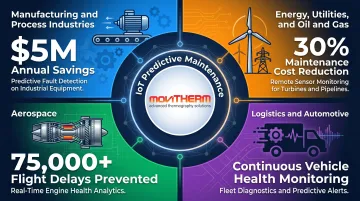
IoT predictive maintenance plays out differently depending on the industry — the sensors, failure modes, and cost stakes vary significantly. Here's how it applies across key sectors.
Manufacturing and Process Industries
Sensors on production machinery detect wear patterns and thermal anomalies before they cause line stoppages. One consumer packaged goods manufacturer documented in Deloitte's research saved $5 million in annual maintenance costs by correlating sensor data with high-speed camera footage to pinpoint root causes of line shutdowns.
Common monitored parameters include:
- Vibration signatures on motors and conveyors
- Thermal anomalies on bearings and electrical components
- Pressure and flow deviations in process equipment
Energy, Utilities, and Oil & Gas
Turbines, transformers, compressors, and pipeline infrastructure are monitored continuously for vibration, temperature, and electrical deviations. Siemens monitors 300+ gas turbines globally using over 1,000 sensors per turbine, with vendor-reported outcomes of 30% maintenance cost reduction and 40% fewer unplanned downtime events.
For electrical utilities, substation monitoring — pairing thermal cameras with UV corona detection — catches transformer degradation before outages occur.
Aerospace, Logistics, and Automotive
- GE Aviation's digital twin program covers 35,000+ aircraft engines, with vendor-reported prevention of 75,000+ flight delays annually and a 50% reduction in unscheduled engine removals
- Fleet operators use onboard IoT sensors to monitor vehicle health continuously in transit, flagging mechanical issues before they cause roadside failures
- Automotive precision equipment relies on thermal and vibration monitoring to hold dimensional tolerances — catching deviations before they reach the finished part
Getting Started with IoT-Enabled Predictive Maintenance
Step 1: Start with a Pilot Asset
Identify your most critical or historically failure-prone equipment. Rank assets by past downtime impact and business cost — not by what's easiest to instrument. The goal is to demonstrate clear ROI quickly, which requires picking an asset where failures are expensive and detectable with available sensor technology.
Step 2: Select the Right Sensors, Tools, and Platform
Different failure modes require different sensors. A motor with bearing wear needs vibration monitoring; an electrical panel needs thermal imaging; a compressor may need both plus pressure monitoring. Key evaluation criteria:
- Asset type and primary failure modes
- Existing connectivity infrastructure (wired vs. wireless)
- Analytics capabilities needed (threshold alerts vs. ML-based prediction)
- Integration requirements with existing CMMS or SCADA systems
For thermal monitoring specifically, ready-to-deploy solutions like MoviTHERM's IoT Monitoring Kit are designed for fast deployment — mount the camera and gateway, connect to the network, and monitoring begins immediately. The iTL Gateway, backed by US-based technical support and commissioning, handles local alarm processing, cloud transmission, and multi-channel notifications without requiring software installation.
Step 3: Monitor, Validate, and Scale
Track the pilot asset's performance data carefully. Compare predictions against actual outcomes — did the system flag a bearing issue that subsequently confirmed during inspection? Document those validation points. Once the strategy proves effective on the pilot asset, expand coverage systematically to additional equipment, building toward plant-wide or enterprise-wide coverage.
On ROI: industry estimates put typical payback at 12–18 months for vibration-based condition monitoring programs, with some implementations reaching breakeven in as few as 6–14 months. Treat these as directional figures — vendor-reported numbers vary, and your actual timeline depends on asset criticality, failure frequency, and implementation costs.
Frequently Asked Questions
What IoT devices and sensors are used for IoT-enabled predictive maintenance?
The primary sensor types are vibration sensors, temperature sensors, thermal/infrared cameras, acoustic emission sensors, pressure sensors, and electrical current sensors. These connect to IoT gateways and cloud platforms — either through wired Ethernet or wireless protocols — to form a complete monitoring system.
What are the main components or pillars of IoT-enabled predictive maintenance?
Four pillars must work together:
- Connected sensors and devices that capture real-time equipment data
- Data communication infrastructure that moves data to centralized systems
- Cloud-based storage that aggregates information from all monitored assets
- Predictive analytics and AI that process data into actionable failure predictions
What are TBM and CBM, and how do they relate to predictive maintenance?
Time-Based Maintenance (TBM) performs maintenance on a fixed schedule regardless of equipment condition. Condition-Based Maintenance (CBM) triggers maintenance when real-time sensor readings cross a threshold. Predictive maintenance is a data-driven evolution of CBM — it uses AI and historical data to forecast failures before threshold breaches occur, enabling intervention at the optimal moment.
Which tools are commonly used for IoT-enabled predictive maintenance?
Key tools include IoT sensor networks, edge computing gateways, cloud storage platforms, CMMS software for work order management, and AI/ML-powered analytics engines.
What is the difference between predictive maintenance and preventive maintenance?
Preventive maintenance follows a fixed schedule regardless of equipment condition. Predictive maintenance uses real-time sensor data and AI to determine the optimal intervention point for each asset — so you're not replacing parts that still have useful life, and you're not waiting until something fails.