Introduction
Most fires don't announce themselves. They start as a smoldering wire inside an electrical panel, a lithium-ion cell climbing toward thermal runaway, or a bearing on a conveyor belt generating friction heat that no one notices. By the time smoke reaches a detector and an alarm sounds, the window for a low-cost, low-risk intervention has often already closed.
That's the problem incipient fire detection systems are designed to solve. These systems target fire in its very first moments—before visible smoke, before flames, before any conventional detector would trigger. For American facilities where fire risk is high and downtime is costly, understanding how they work is the difference between a controlled response and a catastrophic loss.
According to NFPA research, U.S. fire departments respond to an average of 36,784 industrial and manufacturing fires per year, causing $1.5 billion in direct property damage annually. Structure fires account for only 22% of those incidents—but they're responsible for 73% of injuries and 66% of property damage.
Those numbers shift when detection happens before a fire establishes itself. This article explains what incipient fire is, why it's so difficult to catch reliably, and how modern thermal imaging-based systems are closing that gap.
Key Takeaways
- Incipient fire is the pre-combustion stage—heat builds, but there's no visible smoke or flame yet
- Traditional detectors respond after combustion starts; incipient systems detect it before
- Detection approaches range from CO sensors and photoelectric detectors to thermal cameras and multi-sensor fusion — each with different trigger points in the fire progression
- Thermal imaging is the only technology that detects hotspots before any combustion byproduct is released
- Facilities with dust, steam, or ambient process heat — where smoke detectors false-alarm frequently — get the clearest advantage from thermal-based detection
What Is an Incipient Fire?
An incipient fire is a fire in its earliest phase: confined to a small area, producing minimal heat, and still stoppable with basic intervention. It hasn't yet reached the rapid, self-sustaining combustion that makes suppression difficult and damage inevitable.
Fire development follows four recognized stages:
- Incipient/pre-combustion — Heat and combustion gases accumulate without visible flame. This is the critical detection window.
- Growth stage — Ignition occurs; smoke and flame become visible; heat release accelerates
- Fully developed/free-burning stage — Fire spreads rapidly with intense heat; suppression becomes difficult
- Decay stage — Fuel depletes; heat output drops
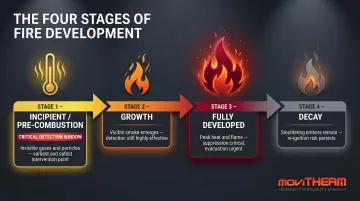
Detection must happen at stage 1 to be genuinely preventive. By the growth stage, suppression costs climb and the window for containment narrows fast.
What Incipient Fires Look Like in Practice
Incipient fires occur regularly across industrial environments:
- A lithium-ion battery cell beginning thermal runaway—internal temperature rising with no external visible indicator
- An overloaded electrical panel slowly heating at a failing connection point
- A conveyor bearing generating abnormal friction heat over hours before any smoke develops
In each case, the hazard is thermal, not yet combustive. Catching it requires a system that reads heat signatures directly — before smoke, flame, or visible damage appear.
Why Early Detection Is So Difficult—and So Critical
The Industrial Detection Challenge
During the incipient stage, fire signatures—heat, smoke, carbon monoxide—are extremely faint. In industrial environments, they're also masked by normal operating conditions: ambient heat from process equipment, airborne dust, steam, chemical vapors, and particulates that mimic smoke signatures.
This creates two distinct failure modes for conventional systems:
- Missed detections — Smoldering sources don't produce the particle distribution that ionization detectors respond to quickly. NIST smoke alarm research confirms that photoelectric detectors respond faster in smoldering scenarios, while ionization detectors are faster in flaming fires—meaning no single conventional detector type covers both well.
- False alarms — Dust, steam, and aerosols regularly trigger optical smoke detectors in industrial settings. When false alarms become routine, safety teams begin disabling or desensitizing detectors—creating dangerous blind spots precisely where incipient detection is most needed.
The False Alarm Cycle
Nuisance alarms in industrial facilities are a genuine safety hazard, not just an operational nuisance. When detectors cry wolf repeatedly, operators stop trusting them. Alarm thresholds get raised, detectors get bypassed, and the system meant to provide early warning becomes the weakest link in the safety chain.
Multi-sensor fusion addresses this directly. Research published in the Fire Safety Journal by Gottuk et al. demonstrates that combining ionization smoke measurements with CO sensor readings—using a product-style algorithm—detects real fire sources faster than either sensor alone while significantly reducing nuisance alarms. CO production during smoldering is a reliable early fire signature that aerosols and steam simply don't replicate.
How Incipient Fire Detection Systems Work
From Threshold to Algorithm
Incipient detection systems monitor continuously for the earliest physical and chemical signatures of fire: temperature rise, particulate accumulation, CO production, and infrared radiation—all before these reach visible or human-detectable levels.
The two main detection approaches differ significantly in reliability:
- Threshold-based alarms trigger when a single sensor reading exceeds a preset cutoff — straightforward, but prone to false positives from industrial particulates and slow to respond when a single signature must climb to a defined level before the alarm fires
- Algorithmic/multi-signature systems combine inputs from multiple sensor types, correlate them against each other, and alarm only when the pattern matches a genuine fire signature — not a nuisance source
CO-plus-smoke fusion is a practical example: CO rises early in smoldering combustion, while smoke particle distribution confirms the source. Neither alone matches both together.
Thermal Imaging: Detection Before Combustion
Thermal imaging cameras represent a fundamentally different approach. Instead of waiting for combustion byproducts to reach a sensor, infrared cameras continuously measure temperature distribution across surfaces and flag areas where temperature deviates from normal operating ranges.
The incipient stage is thermal before it's chemical. A failing bearing, an overloaded circuit, or a battery cell entering runaway all generate measurable heat before any smoke or gas is produced — and thermal cameras catch that signature directly, skipping the wait for combustion byproducts entirely.
Fixed thermal cameras used in fire detection — such as the FLIR A50/A70 Smart Sensor series or the Optris PI 640i CM — achieve thermal sensitivity as fine as 35–40 mK NETD. That means resolving temperature differences of less than one-tenth of a degree Celsius across wide fields of view.
System Integration: What a Complete Solution Looks Like
Modern incipient detection systems are not standalone devices. MoviTHERM's approach—integrating FLIR and Optris thermal cameras with the iTL (Intelligent Thermal Locator) cloud monitoring platform, backed by US-based technical support and commissioning—illustrates how these systems function in practice:
- The iTL Gateway aggregates data from up to eight connected cameras, evaluating temperature readings several times per second
- When a threshold is breached, the Gateway triggers alarms locally and immediately, independent of cloud connectivity
- Alerts go out via text, email, and voice call through a virtual auto-dialer
- The MIO (Intelligent I/O Module) provides Modbus TCP/IP communication and digital relay outputs for integration with PLCs, SCADA systems, and suppression equipment
- The iTL Studio platform logs every temperature event with time-stamped thermal images, trend graphs, and alarm histories—usable for insurance reporting and root cause analysis
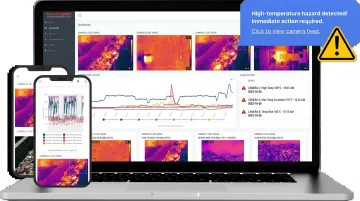
That distinction matters operationally. A standalone camera gives you a thermal image. A complete monitoring system decides what that image means, alerts the right people within seconds, and builds an auditable record — without anyone watching a screen.
Types of Incipient Fire Detection Technologies
Each technology type has distinct strengths and real limitations in industrial environments:
| Technology | Best For | Industrial Challenge |
|---|---|---|
| Ionization smoke | Fast-flaming fires | Slow on smoldering; nuisance from aerosols |
| Photoelectric smoke | Slow-smoldering fires | Vulnerable to dust, steam, stratification |
| CO / multi-gas sensors | Early smoldering detection | Must be paired with smoke for full coverage |
| Heat/rate-of-rise detectors | High-heat environments | Triggers too late for true incipient detection |
| Fixed thermal imaging | Pre-combustion hotspots | Requires proper calibration, emissivity tuning |
Smoke Detectors: Ionization vs. Photoelectric
Ionization detectors use a small radioactive source to ionize air in a sensing chamber, detecting disturbances from combustion particles. They respond quickly to flaming fires but are slower on smoldering sources—and industrial particulates regularly trigger nuisance alarms.
Photoelectric detectors use light scattering to detect larger smoke particles. They outperform ionization types on slow-smoldering fires, but they share the same vulnerability to dust and aerosols, making them unreliable in dusty or aerosol-heavy environments without supplemental sensing.
CO and Multi-Gas Sensors
Carbon monoxide is produced even in early smoldering stages, before visible smoke develops. CO sensors provide a reliable early signature that conventional optical detectors miss. Combined with smoke sensing in a fused algorithm, CO detection achieves both higher sensitivity and lower false alarm rates, an approach Gottuk et al. validated across more than 600 experiments.
Thermal Imaging Cameras
Where gas and smoke sensors detect combustion byproducts after the process has already begun, fixed infrared cameras identify heat anomalies before any byproduct is released — making them uniquely effective for true incipient detection. Key advantages:
- Detect surface temperature anomalies before any combustion byproduct is released
- Operate without generating false alarms from dust, steam, or aerosols
- Cover wide areas continuously, scanning every pixel multiple times per second
- Work at distances where conventional spot detectors have no coverage
For fire detection applications, MoviTHERM deploys cameras including the FLIR A50/A70 (thermal sensitivity <35 mK, temperature range up to 1000°C) and the Optris PI 640i CM (640×480 resolution, 40 mK sensitivity, frame rate 32 Hz, operating range down to -40°C). The Optris PI 450i CM is packaged specifically for outdoor industrial fire detection — including paper mills, biomass plants, and waste recycling facilities — where exposure and continuous operation are primary requirements.
Where Incipient Fire Detection Makes the Biggest Difference
Battery Manufacturing and Energy Storage
Lithium-ion thermal runaway is one of the most dangerous incipient fire scenarios because its earliest stages are invisible. A cell can begin heating internally with no external indicator: no smoke, no visible swelling in early phases, no smell.
By the time a conventional smoke detector registers anything, the cell may already be venting or propagating heat to adjacent cells.
Two standards shape how facilities approach this risk:
- NFPA 855 establishes installation requirements for stationary energy storage systems
- UL 9540A defines the test method for characterizing thermal runaway behavior
Both point toward detection and controls as essential layers in hazard mitigation. Thermal monitoring is the most effective tool for catching cell-level heat anomalies before propagation begins.
MoviTHERM has deployed thermal monitoring systems for battery applications with customers including LG Energy Solution and Tesla at manufacturing facilities in the United States, providing continuous coverage of battery racks and storage systems where the earliest detectable fire signature is thermal.
Recycling, Logistics, and Materials Handling
Conveyor systems, waste sorting lines, and dense storage racks create conditions where heat from friction, compression, or battery thermal runaway can smolder undetected for hours. A peer-reviewed analysis published in Waste Management identifies self-heating, battery thermal runaway, and friction as common ignition causes in waste facilities.
The core problem with conventional detectors is coverage. Smoke must travel from its source to a spot detector, and in large open spaces with high airflow, that delay can be long enough for a smoldering pile to grow significantly.
Fixed thermal cameras mounted over tipping floors, conveyor lines, and storage bunkers eliminate that delay entirely by detecting heat at its source.
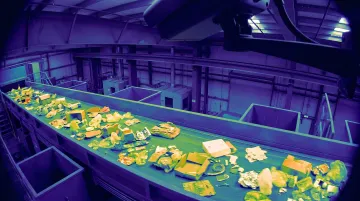
MarBorg Recovery, a U.S. waste management facility using MoviTHERM's iTL thermal monitoring system, noted that the system provides instant alerts showing exactly where heat is building — critical for facilities where fires can ignite during overnight hours with no staff on site.
Process Industries and Manufacturing
Electrical distribution and lighting equipment fires in non-home occupancies cause approximately $718 million in annual property damage, according to NFPA data. Within industrial facilities, electrical panels, motors, transformers, and high-temperature process equipment are all common incipient fire sources.
The heat signature of a failing connection or an overloaded circuit develops over hours or days before ignition. Continuous thermal monitoring of panels, motor control centers, and production line equipment reveals that signature early, turning what would have been an unplanned shutdown or fire event into a scheduled maintenance intervention.
Frequently Asked Questions
Which device is used to detect the incipient stage of fire?
Thermal imaging cameras are the most effective for incipient (pre-combustion) detection, identifying heat anomalies before smoke or flame develop. Multi-sensor systems combining CO sensors and smoke detectors are also used, particularly where thermal imaging isn't the primary technology.
What are the three types of fire detection systems?
The three primary types are smoke detection systems, heat detection systems, and flame detection systems. Advanced incipient systems often combine multiple sensor types or use thermal imaging to detect fire precursors earlier than any single-sensor approach achieves alone.
What does incipient fire mean?
Incipient fire refers to the earliest stage of fire development: heat buildup and early combustion byproducts, with little to no visible smoke or flame. It's the stage where intervention is most effective and where thermal imaging provides the greatest advantage over conventional detectors.
What is an example of an incipient fire?
Practical industrial examples include a lithium-ion battery cell beginning thermal runaway, an electrical panel overheating at a failing connection, or a conveyor bearing generating abnormal friction heat. All produce detectable thermal signatures before ignition.
What should you do if you see an incipient fire?
- Alert others and notify emergency services immediately
- Use an appropriate fire extinguisher only if the fire is small, contained, and you face no personal risk
- Evacuate if the fire is growing, visibility is compromised, or the fuel source is unknown
What are the 4 stages of fire development?
The four stages are incipient (pre-combustion), growth, fully developed, and decay. True incipient detection targets stage one — before visible smoke or flame — when intervention is still practical and damage is still preventable.