Introduction
When a single substation fails, the consequences don't stay local. Hospitals lose backup power margins, factories halt production, and entire neighborhoods go dark — sometimes for hours. ORNL analysis found that major U.S. power outages cost electricity customers an average of $67 billion per year between 2018 and 2024, a figure that makes the case for proactive infrastructure protection far more compellingly than any engineering argument.
The stakes are compounded by how substations now operate. Decades ago, large high-voltage facilities ran with round-the-clock staff. Today, most are unmanned, monitored remotely and inspected on fixed schedules.
That operational shift places enormous responsibility on the automated systems tasked with catching problems between visits — which means the monitoring technology itself is the last line of defense.
This guide covers what a substation monitoring system actually is, its core components, what it tracks, the technologies driving modern deployments (including thermal imaging), and what to evaluate when choosing one.
Key Takeaways
- A substation monitoring system continuously tracks the health of electrical equipment — transformers, breakers, switchgear — using sensors, RTUs, and SCADA software
- Real-time data flows through three tiers — bay-level, station-level, and central network control — giving operators a single view across the entire substation from any location
- Thermal imaging cameras detect hotspots on live equipment weeks before failure, without shutdowns
- Predictive maintenance enabled by continuous monitoring saves up to 40% compared to reactive approaches
- Cybersecurity — encryption, firewalls, and role-based access controls — is now built into modern substation monitoring architecture by design
What Is a Substation Monitoring System?
A substation monitoring system is an integrated set of hardware, software, and communication technologies designed to continuously track the status, performance, and health of every critical asset inside an electrical substation. That includes transformers, circuit breakers, busbars, switchgear, protective relays, and the communication infrastructure tying it all together.
Its core purpose: replace reactive, schedule-driven field inspections with continuous, data-driven surveillance. Problems get flagged in real time, not discovered after a failure.
Two Monitoring Layers
Most systems operate across two distinct layers working in parallel:
- Power equipment monitoring — tracks electrical and physical parameters of high-voltage assets (voltage, current, temperature, load, gas pressure)
- Telecom/SCADA monitoring — protects the communication infrastructure enabling remote control and data transmission
Three Tiers of Supervision
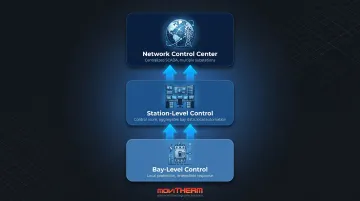
Data flows upward through a standard three-tier architecture:
- Bay-level control — local to each piece of switchgear; handles protection and immediate response
- Station-level control — the substation control room; aggregates bay data and manages local automation
- Network control center — centralized remote oversight via SCADA, covering multiple substations simultaneously
Market Context
According to Global Market Insights, the utility-scale substation monitoring market was valued at $1.6 billion in 2024 and is projected to reach $3.2 billion by 2034 — doubling in a decade. The primary drivers: grid modernization mandates, rapid renewable energy integration, and pressure to extend the life of aging infrastructure. Global grid investment is expected to top $470 billion in 2025, and substation monitoring is a direct beneficiary of that spending.
Key Components of a Substation Monitoring System
Sensors and Intelligent Electronic Devices (IEDs)
Sensors embedded in or attached to substation equipment measure voltage, current, temperature, load, and oil levels continuously. IEDs go further — they process this data locally and execute protection and control actions autonomously, without waiting for commands from a central system.
Remote Terminal Units (RTUs)
RTUs act as the communication bridge between field equipment and the central control system. They aggregate digital and analog signals from sensors and IEDs, then relay structured data to the master station or SCADA. Rugged by design, RTUs hold up to the realities of substation environments: extreme temperatures, electromagnetic interference, and physical vibration.
SCADA / Master Station Software
SCADA (Supervisory Control and Data Acquisition) is the system's brain. It aggregates real-time data from multiple RTUs across many substations into a single centralized interface. From there, operators can:
- View equipment status across the entire portfolio
- Issue control commands (open/close breakers, adjust tap changers)
- Receive and acknowledge alarms
- Review historical trends for root cause analysis
Human-Machine Interface (HMI)
The HMI is the operator-facing layer — visual displays, alarm panels, mimic diagrams, and control consoles. Modern HMIs have evolved from hardwired panel boards to multi-screen digital interfaces with built-in safeguards. Select-check-execute control sequences, for example, prevent accidental operations during high-stress situations.
Communication Infrastructure
Fiber optic and copper wired connections, plus wireless channels, tie field devices to control centers. The IEC 61850 standard is the key protocol enabling interoperability between IEDs from different manufacturers. It standardizes data models and communication services so multi-vendor systems work together without custom integration for every device pair.
| Component | Primary Role |
|---|---|
| Sensors & IEDs | Measure equipment parameters; execute local protection actions |
| RTUs | Aggregate field signals and relay data to the master station |
| SCADA / Master Station | Centralize data, enable control commands, and display alarms |
| HMI | Operator interface for monitoring, control, and alarm management |
| Communication Infrastructure | Connect field devices to control centers via IEC 61850 protocols |
Core Technologies Powering Modern Substation Monitoring
Thermal Imaging Cameras
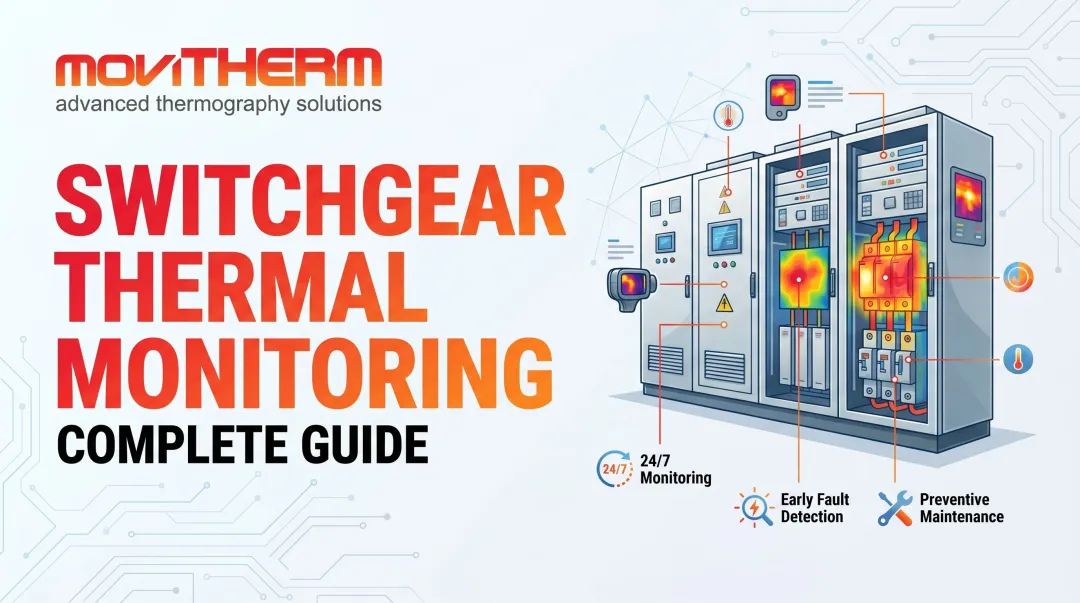
Infrared thermal cameras are among the most powerful tools available for substation condition monitoring. They detect hotspots on energized equipment — loose connections, overloaded busbars, failing transformer insulation, cable termination degradation — without physical contact or equipment shutdown.
Why does this matter? Because thermal anomalies often develop weeks or months before a component actually fails. Catching a busbar connection heating 45°C above its reference temperature gives maintenance teams time to schedule a repair. Discovering the same fault after it trips a breaker means unplanned outages and potentially damaged equipment that costs $500,000 to $3 million to replace — with replacement lead times stretching 36 to 60 months.
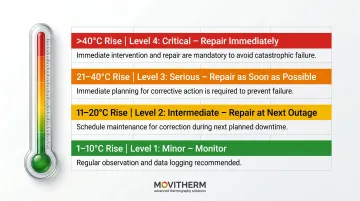
NETA MTS severity thresholds give a practical framework for prioritizing thermal findings:
| Temperature Rise vs. Reference | Severity | Action |
|---|---|---|
| 1–10°C | Minor | Monitor — possible deficiency |
| 11–20°C | Intermediate | Repair at next scheduled outage |
| 21–40°C | Serious | Repair as soon as possible |
| >40°C | Critical | Repair immediately — failure imminent |
MoviTHERM has specialized in continuous industrial thermal monitoring for over 25 years. For substation applications, that means complete systems built around fixed FLIR A-Series cameras — not just the cameras themselves:
- FLIR A50: 464×348 IR resolution, NETD <35 mK
- FLIR A70: 640×480 pixels for wider coverage
- IP67-rated protective enclosures for harsh outdoor environments
- Intelligent I/O Modules (MIO): connect cameras to existing SCADA or PLC systems via Modbus TCP/IP and 4-20mA analog outputs
- iTL cloud monitoring platform: centralizes data and delivers continuous temperature trending without replacing existing infrastructure
The iTL platform delivers alarms via text, email, and automated voice call when thresholds are breached — and critically, the gateway signals alarm conditions locally and independently of cloud update rates, so response doesn't depend on network latency.
IoT Sensors and Edge Computing
IoT-enabled smart sensors feed continuous data streams to edge computing nodes that perform initial filtering and analysis locally before transmitting to SCADA or cloud platforms. This reduces bandwidth demand and enables faster local anomaly responses — important when milliseconds matter for protection functions.
AI and Predictive Analytics
AI algorithms process continuous data streams to separate genuine anomalies from normal operating variation, cutting false alarm rates. Predictive maintenance models use historical trends and real-time inputs to estimate when a component is likely to fail — replacing calendar-based schedules with condition-based intervals.
The results are well-documented. The DOE's Operations & Maintenance Best Practices Guide puts predictive maintenance savings at 8–12% over preventive maintenance and up to 40% over reactive maintenance.
Cybersecurity Layer
As substations become more networked, their attack surface grows. The 2015 Ukraine cyberattack made the consequences concrete: attackers compromised three distribution companies and remotely opened breakers at 30 substations, leaving approximately 225,000 customers without power. Recovery took days — complicated by malware that wiped workstation data and disabled remote access devices.
Modern monitoring systems address this through encrypted communications, Software-Defined Networking (SDN), machine learning-based intrusion detection, and compliance with standards like NERC CIP and IEEE 1686-2022. For modern substation operators, cybersecurity is as much a design requirement as physical protection.
Key Benefits of Real-Time Substation Monitoring
Reduced Downtime and Extended Asset Life
Early detection of thermal anomalies, abnormal dissolved gas levels, or voltage deviations gives maintenance teams the window to intervene before a fault occurs. For large power transformers, the stakes are unusually high. Unit costs run up to $3 million, lead times stretch to five years, and a preventable failure isn't a maintenance event — it's an operational crisis that can take a substation offline for years.
Extended Inspection Intervals and Labor Efficiency
A CHA Consulting analysis of six months of monthly field inspection records across several hundred substations found no significant issues that weren't already detectable through continuous monitoring. That finding validated what many utilities are already doing: transitioning from monthly physical inspections to quarterly or semi-annual schedules.
The freed capacity matters. Skilled field technicians can focus on reliability work that genuinely requires their expertise — not routine walkthroughs of largely unmanned facilities.
Regulatory Compliance and Grid Reliability
Continuous monitoring delivers measurable compliance and operational benefits:
- Supports NERC CIP adherence, particularly CIP-014-3 for physical security of transmission substations
- Generates time-stamped event logs required for root cause analysis after faults
- Provides empirical asset performance data that informs future procurement and substation design
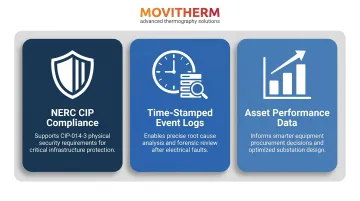
That last point is easy to overlook. Operations teams accumulate years of real-world performance data that engineering can use to make sharper decisions on equipment selection and layout — something periodic inspections rarely capture at scale.
What to Look for When Choosing a Substation Monitoring System
Compatibility and Integration
The system must work with existing equipment, whether through direct IED communication or add-on sensors. IEC 61850 compliance is a strong interoperability indicator.
One hard rule: a monitoring system producing inaccurate or unreliable data is worse than no system at all. Bad data creates false confidence and unnecessary alarms at the same time — often both at once.
Scalability and Total Cost of Ownership
As a utility's substation portfolio grows, the monitoring platform must grow with it. Key considerations here include:
- Adding RTUs and cameras incrementally without rearchitecting the system
- Supporting cloud deployment for centralized visibility across sites
- Carrying manageable long-term software, training, and maintenance costs across the full lifecycle
Vendor Expertise and System Completeness
Complete deployments require vendors who deliver more than hardware: sensors, cameras, networking, alarm software, and integration support all need to work together from day one.
MoviTHERM's engagement model, with US-based technical support and commissioning, covers camera selection, coverage design, mounting configuration, SCADA integration, and ongoing platform support. With over 25 years focused exclusively on thermal imaging, that experience shows in practice — the coverage requirements for a 40-bay transmission substation look nothing like those for a smaller distribution facility, and getting that design right upfront prevents costly rework later.
Frequently Asked Questions
What is SCADA in a substation?
SCADA (Supervisory Control and Data Acquisition) is the software system that aggregates real-time data from RTUs across multiple substations into a central control interface. Operators use it to monitor equipment status, issue control commands, and receive alarms remotely — without being physically present at the substation.
What is the difference between SAS and SCADA?
SCADA is a centralized remote monitoring and control platform operating at the network level. A Substation Automation System (SAS) is the broader automation framework within a single substation — covering protection, local control, interlocking, and data collection — that then feeds data upward to SCADA.
What is IoT-based substation monitoring and controlling?
IoT-based substation monitoring uses networked smart sensors embedded in equipment to continuously collect and transmit data on electrical and physical parameters. This enables real-time remote visibility, automated alerts, and AI-driven predictive analytics — eliminating the need for manual data collection.
What is a transformer monitoring system?
A transformer monitoring system tracks key health indicators — oil temperature, winding temperature, load levels, dissolved gas analysis (DGA), and surface thermal signatures. The goal is catching degradation early, before it leads to catastrophic failure.
What is a fault monitoring system?
A fault monitoring system continuously analyzes electrical parameters — voltage, current, frequency deviations — to detect, classify, and locate faults in real time. When a fault occurs, it triggers automated protection responses (like tripping circuit breakers) and logs time-stamped records for root cause investigation.
What is ECMS in a substation?
ECMS (Equipment Condition Monitoring System) is a platform or subsystem dedicated to continuously assessing the health of individual substation assets. It uses sensor data and analytics to prioritize maintenance actions based on actual equipment condition rather than fixed schedules.