Introduction
Unplanned downtime remains one of the most expensive operational failures in asset-intensive industries. In the automotive sector alone, a single hour of unplanned downtime now costs an average of $2.3 million—a staggering 113% increase since 2019.
Across Fortune Global 500 industrial companies, production outages are projected to erase nearly $1.5 trillion annually, roughly 11% of total revenues. The U.S. Department of Energy puts the cost gap in sharp relief: reactive maintenance runs approximately $18 per horsepower per year, versus just $9 for predictive strategies. Waiting for failure literally doubles the bill.
Modern maintenance and reliability teams face a core challenge: shifting from reactive firefighting (where failures set the schedule) to proactive monitoring that predicts and prevents breakdowns before they occur. Asset Performance Monitoring (APM) addresses this directly, combining sensor data, analytics, and continuous surveillance to detect degradation early, optimize maintenance timing, and extend equipment lifespan.
This guide covers what APM is, how it works, its core technology components, how to measure success through key performance indicators, and which industries benefit most from deployment.
TLDR:
- APM combines strategy, sensors, and software to continuously monitor physical asset health and prevent unplanned failures
- Predictive maintenance enabled by APM reduces downtime 35–45% and cuts maintenance costs 25–30% on average
- Core components: condition monitoring sensors, IIoT connectivity, AI-driven analytics, and digital twins
- Key metrics are MTBF (time between failures), OEE (availability × performance × quality), and planned vs. unplanned maintenance ratio
- Asset-intensive sectors—manufacturing, energy, utilities, aerospace—see the highest ROI from APM deployment
What Is Asset Performance Monitoring (APM)?
Asset Performance Monitoring is a combination of strategy, processes, and software tools that continuously collect, analyze, and act on physical asset data to maximize reliability, minimize unplanned downtime, and extend operational lifespan.
The "monitoring" in APM refers specifically to continuous data capture—sensors measuring vibration, temperature, pressure, and other health signals in real time. The broader management layer adds strategy, workflow integration, and execution across the asset lifecycle.
From Reactive Paper Logs to AI-Enabled Platforms
APM's roots trace back to the 1990s, when computerized maintenance management systems (CMMS) and enterprise asset management (EAM) platforms began digitizing maintenance workflows. APM emerged as a distinct software category in the early 2000s, layering real-time condition data on top of work-order systems. Over the past five years, investment has accelerated dramatically: the global APM market was valued at $26.51 billion in 2025 and is projected to reach $67.50 billion by 2033, growing at a 12.5% compound annual rate. This surge reflects the rapid adoption of Industrial IoT (IIoT) sensors, cloud analytics, and machine learning models that can detect subtle failure signatures weeks or months before breakdown.
APM vs. Asset Lifecycle Management (ALM)
ALM spans every stage of an asset's existence—from acquisition and design through installation, operation, maintenance, and eventual decommissioning. APM focuses specifically on optimizing performance during the active utilization phase, when equipment is generating value and at risk of failure. ALM is the full lifecycle roadmap; APM is the real-time operations layer that keeps assets running efficiently within it.
APM vs. CMMS: Complementary, Not Competing
A CMMS manages the administrative side of maintenance: work orders, technician scheduling, parts inventory, and task checklists. APM ingests real-time sensor and operational data to predict when maintenance should be scheduled and what actions are required. CMMS tells teams what to do and when based on a calendar or manual inspection; APM tells teams when based on actual asset condition and why the intervention is needed. In mature maintenance ecosystems, both coexist and exchange data—APM analytics trigger CMMS work orders, and CMMS logs feed back into APM historical models.
Beyond Software: People, Process, and Culture
Deploying APM is not just a technology project. Success requires alignment across people, processes, and data infrastructure:
- Maintenance technicians must trust sensor alerts and shift from time-based routines to condition-based triggers
- Reliability engineers need access to real-time dashboards and historical trend data
- Operations teams must break down silos between production, quality, and maintenance to enable cross-functional problem-solving
Companies that establish data-sharing practices before rolling out APM tools consistently reach full productivity faster and see measurable ROI within the first year of deployment.
Key Benefits of Asset Performance Monitoring
From Break-Fix to Condition-Based Maintenance
APM enables a strategic shift from reactive break-fix mode to condition-based maintenance, where interventions are triggered by actual asset health signals rather than arbitrary schedules or catastrophic failures. This avoids both over-maintenance (servicing healthy equipment unnecessarily) and under-maintenance (missing hidden degradation between inspections).
The cost case is clear: the U.S. Department of Energy reports that predictive maintenance costs 30–40% less than reactive approaches, with returns on investment reaching up to 10x for well-executed programs.
Lower Maintenance Costs Through Smarter Resource Allocation
When maintenance is driven by real-time condition data, teams focus only on assets that actually need attention. The downstream effects add up quickly:
- Unnecessary parts consumption drops
- Labor hours shift to genuine problems instead of scheduled checks
- Emergency call-outs decline
Predictive maintenance programs reduce overall maintenance costs by 25–30% on average by eliminating waste and improving first-time fix rates.
Extended Asset Lifespan, Improved Safety, and Easier Compliance
Cost reduction is only part of the picture. APM also extends asset life, protects workers, and simplifies compliance:
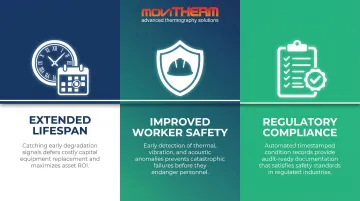
- Extended lifespan: By catching degradation early—before minor issues cascade into major component damage—APM extends the useful life of expensive assets, deferring capital replacement costs.
- Improved worker safety: Thermal hot spots, vibration anomalies, and acoustic discharge signals often precede hazardous failures such as explosions, fires, or mechanical breakage. Early detection allows teams to intervene before incidents occur, protecting personnel.
- Regulatory compliance: APM systems generate auditable, timestamped condition records that demonstrate proactive maintenance and adherence to safety standards—critical in regulated industries such as utilities, aviation, and oil and gas.
Core Components of an APM System
Condition Monitoring Sensors: The Data Acquisition Layer
Sensors are the eyes and ears of an APM system, each capturing a different failure signature:
- Vibration sensors (accelerometers, velocity transducers, proximity probes) detect bearing wear, gear damage, misalignment, unbalance, and looseness in rotating machinery.
- Temperature sensors (resistance temperature detectors, thermocouples, infrared/thermal cameras) identify frictional heating, electrical hot spots, and thermal anomalies across motors, panels, and process lines.
- Acoustic and ultrasonic sensors detect electrical issues such as corona discharge, arcing, and tracking, as well as early leak detection in compressed air, steam, and gas systems.
- Dynamic pressure sensors capture combustion dynamics, flow turbulence, and cavitation in pumps and compressors.
- Motor current analysis systems detect rotor bar degradation, eccentric rotors, loose windings, and supply voltage unbalance.
- Oil analysis instruments measure wear metals, particle counts, viscosity changes, and moisture contamination—early indicators of lubrication breakdown and component wear.
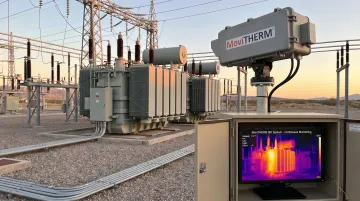
Thermal imaging cameras deserve a closer look in this context. Unlike point sensors, a single fixed thermal camera scans hundreds of components simultaneously without equipment shutdown—identifying hot spots in electrical panels, motors, and process lines within seconds. MoviTHERM's iTL cloud monitoring platform feeds that continuous thermal data stream directly into APM infrastructure for 24/7 remote surveillance.
Source: National Instruments sensor fundamentals for condition monitoring
Industrial IoT (IIoT) Connectivity: Moving Data from Sensor to Platform
Sensors generate the signal—but that data is only useful once it reaches an analytics platform. Connectivity options include:
- Wired Ethernet/IP: High reliability, low latency, best for fixed installations with existing network infrastructure.
- Wireless (Wi-Fi, cellular, LoRaWAN): Flexible deployment in remote or hazardous locations where cabling is impractical.
- Edge gateways: Local processing units that aggregate, filter, and pre-process sensor data before sending it to the cloud, reducing bandwidth and enabling real-time alerting even during network interruptions.
Data quality, sampling frequency, and network reliability all determine what the analytics layer can actually do. APM platforms typically require sampling rates from 1 Hz to several kHz, depending on the asset and the failure mode being tracked.
The Analytics Engine: From Descriptive to Prescriptive
Modern APM platforms process sensor data through four tiers of sophistication:
- Descriptive analytics: Dashboards display current and historical temperatures, vibration levels, and operating conditions to show what happened.
- Diagnostic analytics: Root-cause analysis tools correlate sensor anomalies with maintenance logs, operating events, and environmental factors to explain why it happened.
- Predictive analytics: Machine learning models analyze patterns to forecast component failure days, weeks, or months in advance.
- Prescriptive analytics: Advanced platforms recommend specific actions—replace a bearing, adjust lubrication intervals, rebalance a motor—along with optimal timing and resource requirements, closing the loop from data to decision to execution.

These models improve with each failure event they process—most mature deployments see meaningful false alarm reduction within the first 12 to 18 months of operation.
Digital Twins: Virtual Replicas for Nuanced Fault Detection
A digital twin is a computer model of a physical asset—a pump, turbine, production line, or entire facility—that incorporates real-time sensor data and historical performance to simulate behavior and detect subtle deviations from expected operation. NIST defines a digital twin as having the potential for high accuracy, precision, and flexibility in observing, diagnosing, predicting, and optimizing manufacturing systems.
Digital twins move organizations beyond simple threshold alarms ("temperature exceeds 80°C") into nuanced early-warning detection that recognizes complex, multi-variable failure signatures. For example, a digital twin can detect that a motor is operating at normal temperature and vibration individually, but the combination of slightly elevated temperature with a subtle shift in vibration frequency indicates impending bearing failure—a pattern that single-sensor thresholds would miss.
Alerting, Reporting, and Integration
APM platforms generate prioritized alerts through multiple channels:
- Real-time dashboards with health scores, trend charts, and asset location maps
- Email and SMS notifications for critical anomalies as they develop
- Automated voice calls for urgent failures that require immediate human response
Integration with EAM and ERP systems ensures that maintenance actions, work orders, parts procurement, and asset history remain synchronized. When APM detects a failing component, the system can automatically generate a CMMS work order, reserve required parts from inventory, and notify the assigned technician—accelerating response and cutting unplanned downtime.
Reactive vs. Preventive vs. Predictive Maintenance: The APM Spectrum
Reactive Maintenance: The High-Cost Default
Reactive maintenance—also called run-to-failure or break-fix—is the default starting point for many organizations. Equipment runs until it breaks, then repair crews scramble to restore service. While it requires minimal upfront investment in monitoring infrastructure, the total cost of ownership is high due to:
- Unplanned production halts that cascade through schedules
- Secondary damage when one failed component damages adjacent systems
- Safety risks from sudden, catastrophic failures
- Emergency labor premiums (overtime, call-outs, expedited shipping)
Most mature organizations actively work to reduce reactive maintenance as a percentage of total workload.
Preventive Maintenance: Scheduled but Imprecise
Preventive maintenance schedules work based on time or usage intervals—every 1,000 operating hours, every 30 days, or every production batch. It's a significant improvement over reactive mode, reducing unexpected breakdowns and providing predictable work schedules. However, it's inherently imprecise because it ignores actual asset condition:
- Healthy equipment is serviced unnecessarily, wasting parts and labor
- Degraded equipment fails between scheduled intervals because the calendar doesn't match real-world wear rates
That gap between scheduled service and actual asset condition is exactly what continuous monitoring addresses.
Condition-Based and Predictive Maintenance: Monitor, Then Act
Continuous monitoring data enables intervention only when asset health signals indicate a real need. Two variations exist:
- Condition-based maintenance (CBM): Act when a monitored parameter crosses a threshold (e.g., bearing temperature exceeds 85°C or vibration amplitude exceeds 10 mm/s). This is still reactive to the sensor reading but proactive relative to failure.
- Predictive maintenance (PdM): Act based on a forecast of when a threshold will be crossed or failure will occur. Machine learning models analyze trends to predict, for example, that a bearing will fail in 14 days based on its current rate of temperature rise and vibration increase.
The performance data behind predictive maintenance is hard to ignore. U.S. DOE research shows it reduces downtime by 35–45% and eliminates 70–75% of breakdowns, with maintenance cost reductions of 25–30% and ROI up to 10x. Deloitte case studies add further detail:
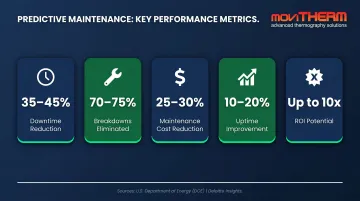
- Uptime improvements of 10–20%
- Planning time reductions of 20–50%
- Overall maintenance cost reductions of 5–10%
- Select deployments—such as Trenitalia's rail fleet—achieving annual savings near $100 million
Prescriptive Maintenance: The Emerging Frontier
Prescriptive maintenance takes predictive analytics one step further. AI-driven APM platforms don't just forecast when a failure will occur—they recommend exactly what to do about it:
- Action: Replace, repair, or adjust the affected component
- Timing: Before the next production batch, during a scheduled shutdown, or within a defined window
- Resources: Part numbers, required technician skill level, and estimated labor hours
This closes the loop from data to decision to execution, reducing reliance on individual interpretation and keeping maintenance teams aligned on priorities.
How to Measure Asset Performance: Key KPIs
Mean Time Between Failures (MTBF)
MTBF measures reliability: total operating time divided by the number of failures over a period. A rising MTBF trend indicates healthier assets and a maturing APM program. SMRP Best Practices define it as the standard reliability metric for repairable systems.
For example, if a pump runs 8,000 hours and experiences 4 failures, MTBF = 2,000 hours — a straightforward calculation that makes this the most widely tracked maintenance KPI across industries.
Overall Equipment Effectiveness (OEE)
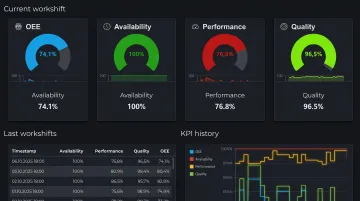
OEE is a three-factor formula that captures how productively an asset operates relative to its theoretical maximum:
OEE = Availability × Performance × Quality
- Availability: Percentage of scheduled time the asset is running (accounts for downtime)
- Performance: Speed at which the asset operates compared to design capacity (accounts for slowdowns)
- Quality: Percentage of output meeting quality standards (accounts for defects and rework)
World-class OEE is often benchmarked at 85%, rooted in Seiichi Nakajima's Total Productive Maintenance (TPM) methodology. However, real-world analysis of 3,500+ machines across 50+ countries shows that average OEE hovers around 55–60%, with only ~6% of manufacturers achieving 85% or above. A rising OEE directly reflects APM-driven improvements in uptime, throughput, and output quality.
Planned vs. Unplanned Maintenance Ratio and Emergency Frequency
Tracking what percentage of maintenance activities were scheduled versus reactive reveals whether an APM program is actually shifting the organization's maintenance posture. High-performing organizations target 80–90% planned work, with emergency interventions reserved for truly unpredictable events. Monitoring emergency maintenance frequency over time — how often true "drop everything" failures occur — provides a clear signal of APM effectiveness.
Industries That Benefit Most from APM
Manufacturing and Automotive
High-throughput production lines depend on APM to maximize OEE, prevent bottlenecks from isolated equipment failures, and compensate for shrinking skilled maintenance workforces through automated monitoring and intuitive dashboards. Those stakes are concrete: a single hour of unplanned downtime in automotive now costs $2.3 million.
Battery manufacturing is an especially critical emerging use case. Lithium-ion cell production demands rigorous thermal management to prevent thermal runaway (a rapid, uncontrolled temperature escalation that can lead to fires or explosions). NREL peer-reviewed research highlights that typical battery management systems relying on surface temperature and voltage may not prevent thermal runaway, underscoring the need for rapid, granular monitoring.
Continuous thermal imaging surveillance — such as MoviTHERM's fixed-camera systems with 24/7 cloud monitoring — provides the speed and coverage required to detect hot spots and cell-to-cell propagation risks in real time.
Energy, Oil & Gas, and Utilities
Asset-intensive infrastructure — offshore platforms, pipelines, substations, wind turbines, solar arrays, and battery energy storage systems (BESS) — often operates in remote or harsh environments where manual inspections are costly, dangerous, or infrequent. APM is critical for:
- Monitoring remote assets via sensors and satellite/cellular connectivity, covering sites hundreds of miles from the nearest technician
- Tracking metal loss in pipelines and pressure vessels using ultrasonic thickness gauges and corrosion probes
- Detecting hot spots in switchgear, transformers, and bus bars before substation insulation fails or fires ignite
- Maximizing energy output from wind turbines and solar inverters through vibration analysis and thermal monitoring
- Meeting NFPA 855, UL 9540, and UL 9540A compliance requirements for utility-scale BESS installations, where continuous thermal imaging catches overheating cells before cascading failures develop
Aerospace, Defense, and Process Industries
In commercial and military aviation, chemical processing, refining, and defense manufacturing, APM is required not only for operational efficiency but also for regulatory compliance and audit trail documentation. IATA estimates that predictive health monitoring can save airlines approximately $3 billion per year in maintenance costs, with dispatch delays costing $10,000+ per hour and cancellations exceeding $100,000 per event.
Aircraft Health Monitoring/Management (AHM) systems continuously track engine vibration, oil analysis, and thermal signatures to predict failures and optimize maintenance intervals within FAA AC 43-218, EASA Part-M/Part-CAMO, and MSG-3 frameworks.
In process industries, APM reduces the risk of hazardous material releases, prevents costly batch losses, and maintains compliance with OSHA, EPA, and industry-specific safety regulations.
Frequently Asked Questions
What is asset performance monitoring?
Asset Performance Monitoring (APM) is the continuous collection and analysis of physical asset data—through sensors, software, and analytics—to detect degradation early, prevent unplanned failures, and optimize maintenance decisions throughout the asset's operational life.
How do you measure asset performance?
Asset performance is measured using KPIs such as MTBF (mean time between failures), OEE (overall equipment effectiveness: availability × performance × quality), and the ratio of planned to unplanned maintenance. The right metrics depend on asset type and operational context.
What are the 5 P's of asset management?
The 5 P's are People, Processes, Physical assets, Performance, and Planning. APM supports each dimension by providing real-time data and condition visibility that keeps teams and workflows aligned around asset health goals.
What is the difference between APM and predictive maintenance?
Predictive maintenance is one strategy within the broader APM framework. APM encompasses the full system of sensors, analytics, software, and workflows that continuously monitor asset health. Predictive maintenance is specifically the use of real-time condition data to forecast and preempt failures before they occur.
What types of sensors are used in asset performance monitoring?
Common sensor types include:
- Vibration accelerometers — rotating equipment health
- Thermal/infrared cameras — hot spots and electrical faults
- Pressure transducers — fluid system integrity
- Acoustic ultrasound probes — leaks and electrical discharge
- Oil analysis systems — lubricant condition
Using multiple sensor types together improves detection accuracy across failure modes.
How does APM differ from a CMMS?
A CMMS (Computerized Maintenance Management System) is a work-order and scheduling platform that manages maintenance execution—who does what, when, and with which parts. APM is a data-driven condition monitoring platform that uses real-time sensor data to predict when maintenance is needed and why. The two are complementary and are often integrated in mature maintenance ecosystems.
Ready to deploy continuous thermal monitoring for your critical assets? MoviTHERM specializes in fixed thermal imaging systems, industrial camera enclosures, and cloud-based condition monitoring platforms built for continuous APM deployments. Reach the team at (949) 699-6600 or info@movitherm.com to discuss your application.